If you want to grow your money over time, you are going to bump into stocks sooner or later. Stocks are basically small pieces of real businesses, and for many people they are the main engine behind long term wealth. They can also be stressful, risky and confusing if no one has ever explained them to you properly.
So let's fix that. In this guide I will walk you through what stocks actually are, how they work in the real world, why companies issue them, how you can invest, and how to manage the risks that come with them.
This guide is for you if you are a complete beginner, a new DIY investor, a forex or crypto trader looking at stocks for the first time, or a long term investor comparing stocks against other assets.
Stocks, explained
When people talk about the stock market , it can sound like this big mysterious machine. At the heart of it, it is just people buying and selling ownership in real companies.

Simple definition
A stock is a type of security that represents a share of ownership in a company. You will also hear people say “equity” or “share”. In normal conversation, those words are basically the same thing. If you own stock in a company, you are a partial owner of that business and you may have a claim on its profits and certain rights, like voting on some company decisions.
So when you hear “I own Apple stock”, that literally means “I own a small piece of Apple as a business”.
An example
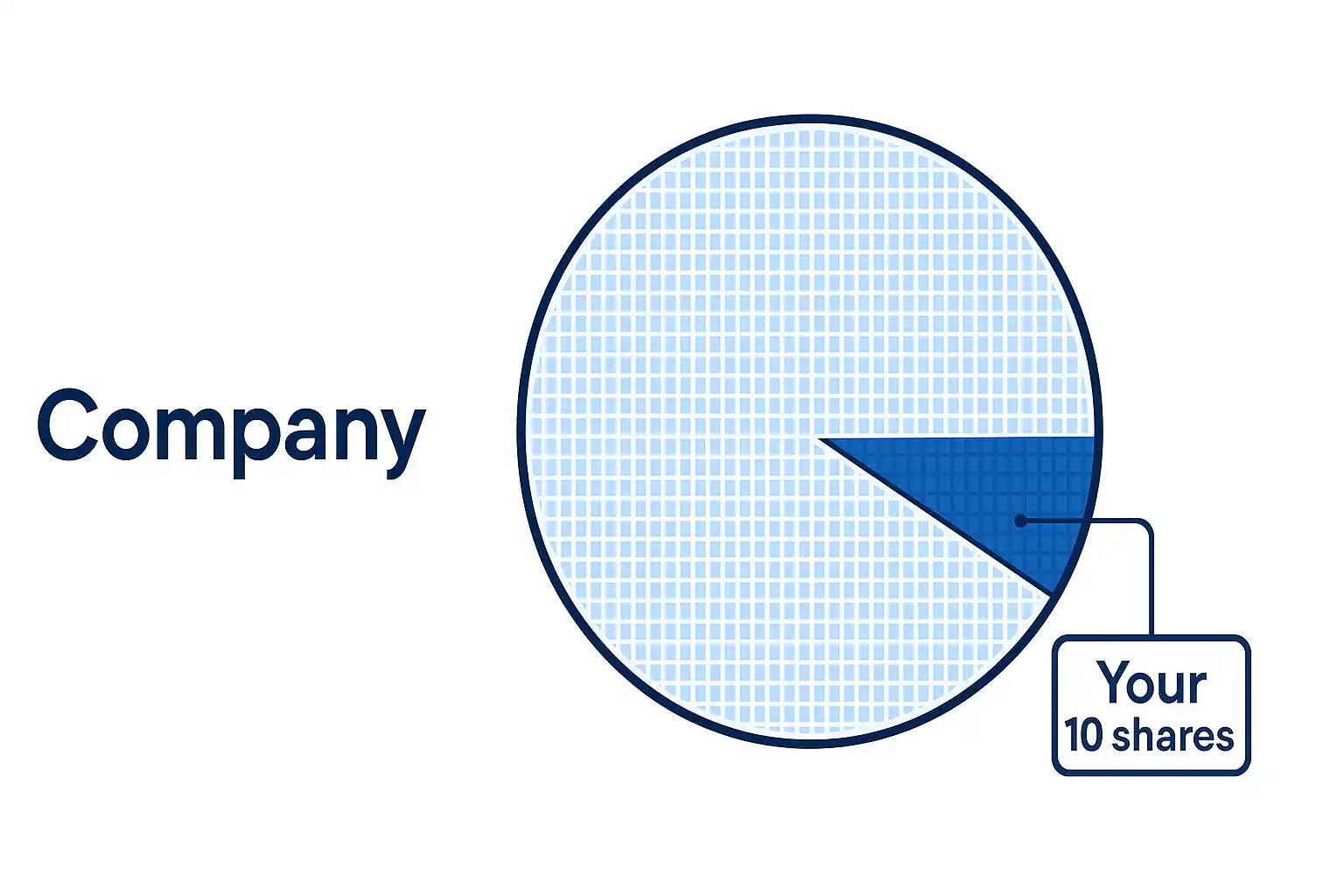
Let's keep it super simple. Imagine a small company has issued 1,000 shares in total.
- If you buy 10 shares, you own 10 / 1,000, so 1% of the company.
- If the share price is 20 dollars, your 10 shares are worth 200 dollars.
- If the share price later moves to 30 dollars, you still own 1% of the company, but that 1% is now worth 300 dollars.
Your percentage ownership only changes if new shares are issued or you buy or sell shares. The daily ups and downs in price do not change your percentage, they only change the current market value of what you already own.
This is a small detail but an important mental shift. You are not just trading numbers on a screen, you are holding a slice of a living business.
Stocks vs the company itself
Owning stock does not mean you can walk into the company headquarters and help yourself to laptops.
What you own is:
- A claim on potential profits
- A claim on assets if the company is ever shut down, after debts are paid
- Some rights around information and voting, depending on the stock type
The people actually running the company day to day are the executives and managers. Shareholders (you) own the company. Directors and management run it on your behalf.
This separation between ownership and management is standard corporate structure and is explained in more formal language on many investor education sites.
Why companies issue stocks
So why would a company share the pie with you at all?
Raising capital through equity
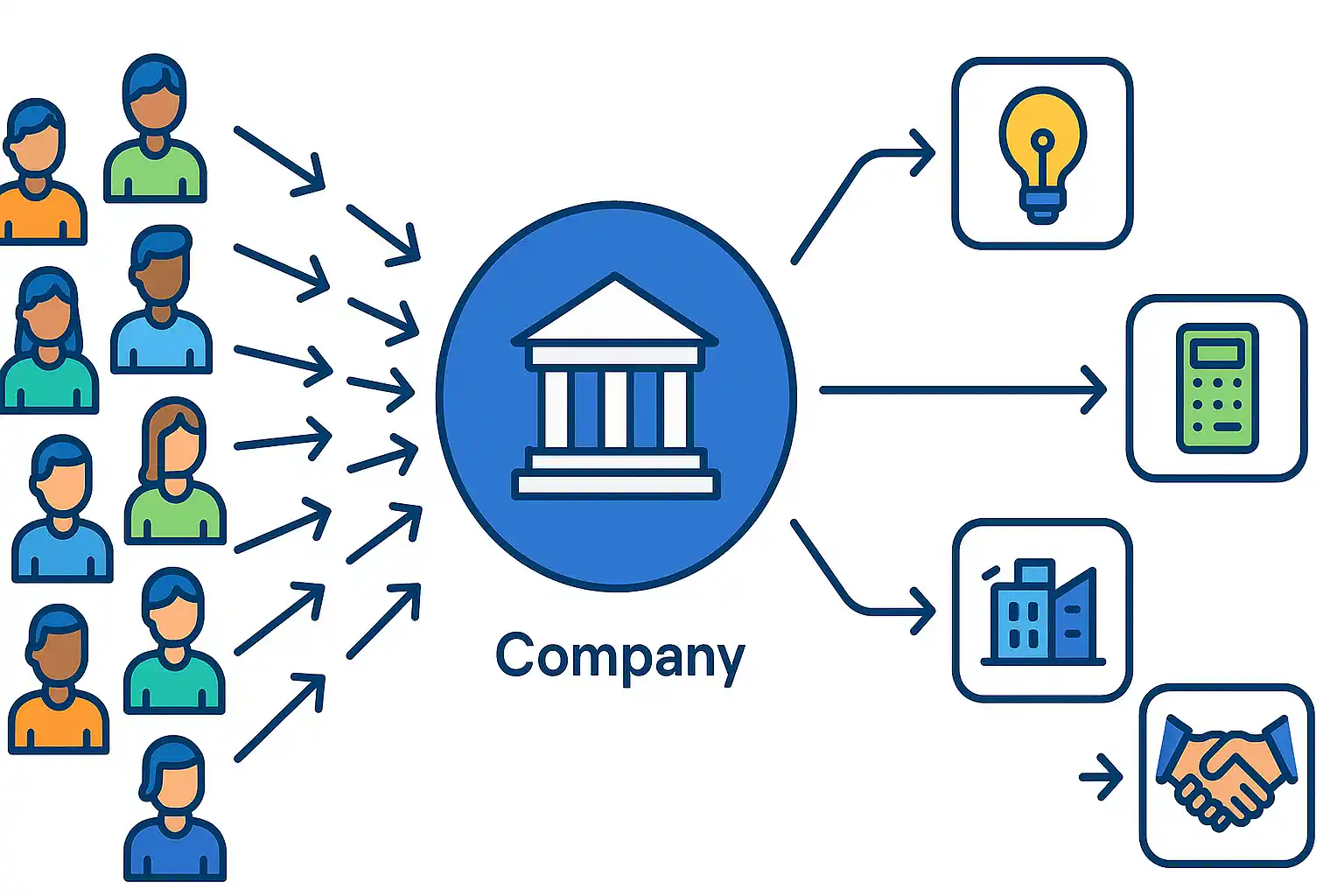
When a company issues stock, it is basically saying:
We will give you a piece of ownership, if you give us cash to grow the business.
That cash can be used to:
- Launch new products
- Open offices in other cities or countries
- Invest in research and development
- Pay down existing debt
- Buy other companies
Regulators and investor education sites list these reasons clearly, which is why you will see companies selling stock around big growth plans or after a large acquisition.
IPO and the primary market
The first time a company sells its shares to the general public is called an Initial Public Offering, or IPO.
- Before the IPO, the company might be owned by founders, early employees and private investors.
- During the IPO, new shares are created and sold to investors, usually with the help of investment banks.
- Money from these new shares goes to the company itself. This is the “primary market”.
After the IPO, shares start trading on a stock exchange. At that point, investors are mostly buying from and selling to each other in the “secondary market”, not directly to the company.
Sometimes companies choose other routes like direct listings or going public via a SPAC. For you as a regular investor, the main idea is the same. Before listing, you cannot easily trade the shares. After listing, you can.
Equity financing vs debt financing
Companies have two main ways to fund themselves:
- Equity : sell pieces of ownership (stocks)
- Debt : borrow money by issuing bonds or taking loans
Key differences, roughly:
- With equity, the company does not have to pay the money back on a schedule, but it has shared ownership and future profits with you.
- With debt, the company must pay regular interest and repay principal, but it keeps full ownership.
Education pages from major finance sites show that equity is usually seen as riskier but with higher potential returns, while bonds are more conservative with lower upside .
This is why you will later hear a lot about “stocks vs bonds” when we talk about portfolios.
How stocks work
You now know what a stock is in theory. Let us plug it into the real market.
Ownership, rights and limited liability
If you own common stock in a public company, you usually get:
- The right to vote on certain major company matters, often one vote per share
- The possibility of receiving dividends if the company decides to distribute profits
- A residual claim on assets if the company is liquidated, after bonds and preferred stock are paid
Important concept here is limited liability .
If you buy 1,000 dollars of stock in a company and the company fails, the most you can lose is that 1,000 dollars, assuming you did not use margin or any fancy derivatives. Creditors cannot come after your car or your house just because you owned shares.
That protection is a big part of why stock markets even exist.
Primary vs secondary markets
We already touched this, but let us make it crystal clear.
- Primary market : new shares are created and sold to investors, usually in an IPO or a follow on offering. The company receives the money.
- Secondary market : existing shares are traded between investors. When you buy Apple stock on your broker app today, you are most likely buying from another investor, not from Apple. The price changes based on supply and demand.
Most of what you do as a retail trader or investor is in the secondary market.
Stock exchanges and trading hours
Stocks in most big markets trade on organized exchanges like the New York Stock Exchange (NYSE) and Nasdaq in the US, the London Stock Exchange in the UK, and so on.
In the US, normal trading hours are roughly:
- 9:30 a.m. to 4:00 p.m. Eastern Time, Monday to Friday, excluding holidays
Many brokers also offer:
- Pre market sessions before the open
- After hours sessions after the close
These extra sessions can be less liquid and more volatile, so if you are a beginner, you usually just stick to regular hours at first.
If you come from forex or crypto, this is a big difference. Forex trades almost 24 hours during weekdays. Many crypto markets are open 24/7. Stocks do not behave like that, and you will feel it the first time you want to trade Sunday afternoon and nothing moves.
How stock prices are set
This is the part that sometimes looks like magic. It is not.
At any moment, there is a list of people willing to buy a stock at certain prices, and a list of people willing to sell at certain prices.
- If there are more eager buyers than sellers, the price tends to move up.
- If there are more eager sellers than buyers, the price tends to move down.
What makes people eager to buy or sell? Mainly expectations about:
- Future profits and cash flows
- Interest rates and inflation
- News about the company, its competitors and the economy
News sites and brokers talk a lot about these factors, but under the hood it is still just orders matching between buyers and sellers.
How investors make money from stocks
There are two main ways you can make money.
-
Capital appreciation
You buy a stock at 50 dollars, later sell at 60 dollars, you made 10 dollars per share before fees and taxes. That is capital gain. If you sell at 40 dollars, you have a capital loss instead. -
Dividends
Some companies regularly share part of their profits with shareholders as cash payments, called dividends. For many mature companies, dividend yields often sit somewhere around 1 to 3 percent of the share price, sometimes higher, sometimes lower.
Growth stocks often pay little or no dividend. They prefer to reinvest profit back into the business. Income stocks, like utilities or real estate investment trusts (REITs), often pay higher dividends and attract investors who want regular cash flow.
In practice, many investors use a mix of both approaches.
Reinvestment and compounding (DRIPs)
If your broker or the company offers a Dividend Reinvestment Plan, usually called a DRIP, you can choose to automatically reinvest dividends into more shares instead of taking the cash out.
This does two nice things for you:
- Every dividend buys a little more stock
- Each extra bit of stock can then earn more dividends in the future
Over long periods, this compounding effect can be powerful. It is not magic, but if you stick with it, it often matters more than trying to predict every short term price move.
Types of Stocks
Not all stocks are the same. If you are going to put your money at risk, it helps to know which flavor you are buying.
Common vs preferred stock
Common stock
When someone says “I own stock in Company X”, they are almost always talking about common stock.
Typical features:
- Voting rights on some company matters
- Potential, but not guaranteed, dividends
- Last in line in a bankruptcy, after bondholders and preferred shareholders
In return for being last in line, common stock usually gets the most upside if the company does well.
Preferred stock
Preferred stock is a hybrid between bonds and common stock.
Typical features:
- Usually no voting rights
- Pays a fixed or stated dividend, if the company has enough cash
- Gets priority over common shares for dividends and in liquidation
Some preferred shares are convertible , which means they can be converted into common stock under certain conditions. You will bump into these more if you dig into more advanced investing or corporate finance.
For most everyday investors, common shares are the main focus. Preferred shares can make sense when you care more about steady income than voting rights or huge upside.
Public vs private company stock
Public stock
Public companies list their shares on a stock exchange. This means anyone with a brokerage account can buy and sell their shares, and they must follow disclosure rules, filing regular financial reports with regulators like the SEC in the US.
If you are trading or investing through a normal broker, you are dealing with public stocks almost all the time.
Private stock
Private companies are not listed on public exchanges.
- Their shares are usually held by founders, employees, venture capital funds or other private investors
- There is no public market where you can easily trade these shares
- Financial info may be limited, since they do not have to publish as much as public companies
You might meet private stock if you join a startup and receive equity, or if you invest through private markets or crowdfunding platforms. Liquidity and transparency are the big differences here.
Market capitalization: large, mid, small, micro and penny stocks
Market cap is just:
Share price x number of shares outstanding.
It is a quick way of saying “how big is this company in market terms”.
Typical labels:
- Large cap : big, established companies, usually many billions in value
- Mid cap : mid sized companies, often still growing
- Small cap : smaller companies, often with higher growth potential and higher risk
- Micro cap and penny stocks : small, often thinly traded companies, sometimes with low share prices
Small, micro and penny stocks can move fast. They can make or lose you a lot of money quickly, and some are targets for pump and dump schemes. Regulators warn strongly about this segment.
If you are a beginner, be extra careful around anything that sounds like “get rich quick” in this space.
Sectors, industries and cyclical vs defensive stocks
To make sense of thousands of stocks, the market groups companies into sectors and industries.
Common sectors include:
- Technology
- Financials
- Healthcare
- Consumer staples
- Consumer discretionary
- Energy
- Utilities
- Industrials
You will also hear about:
- Cyclical stocks : companies that tend to do well when the economy is strong and struggle when it is weak, for example travel, luxury goods, some industrial businesses
- Defensive stocks : companies that sell essentials people still buy even in recessions, like utilities or consumer staples
If you put all your money into one sector, you are exposed to the specific risks of that area. Sector diversification is a simple way to spread your bets out a bit.
Growth vs value vs income vs blue chip vs speculative
Here is a quick tour of some common labels you will see:
Growth stocks
These are companies where investors expect earnings and revenue to grow quickly. They often reinvest profits rather than paying dividends, can trade at high valuation ratios, and prices can be sensitive to news.
If you are a more aggressive investor, you might like growth stocks, but you have to accept bigger swings.
Value stocks
Value investors look for companies whose stocks appear cheap relative to their fundamentals, such as earnings, cash flow or assets. The hope is the market eventually realises the value and the price rises. The risk is the stock stays cheap for good reasons, often called a “value trap”.
This style is more about patience and analysis than excitement.
Income stocks
Income stocks are known for paying reliable, above average dividends. You often find them in utilities, telecoms, some financials and REITs. They are good for investors who want regular cash flow, but remember, dividends can be cut if the business runs into trouble.
Blue chip stocks
Blue chips are large, financially strong, well known companies with long track records. Many pay consistent dividends. If you are a beginner, blue chips and broad index funds that hold them are often a calmer entry point than tiny speculative names.
Speculative or momentum stocks
Here you are basically betting on stories and strong price trends. Meme stocks are a recent example. These can move 20 percent in a day in either direction. If you are going to play here, treat it like the high risk bucket in your portfolio, not your retirement plan.
Stocks vs Other Investments
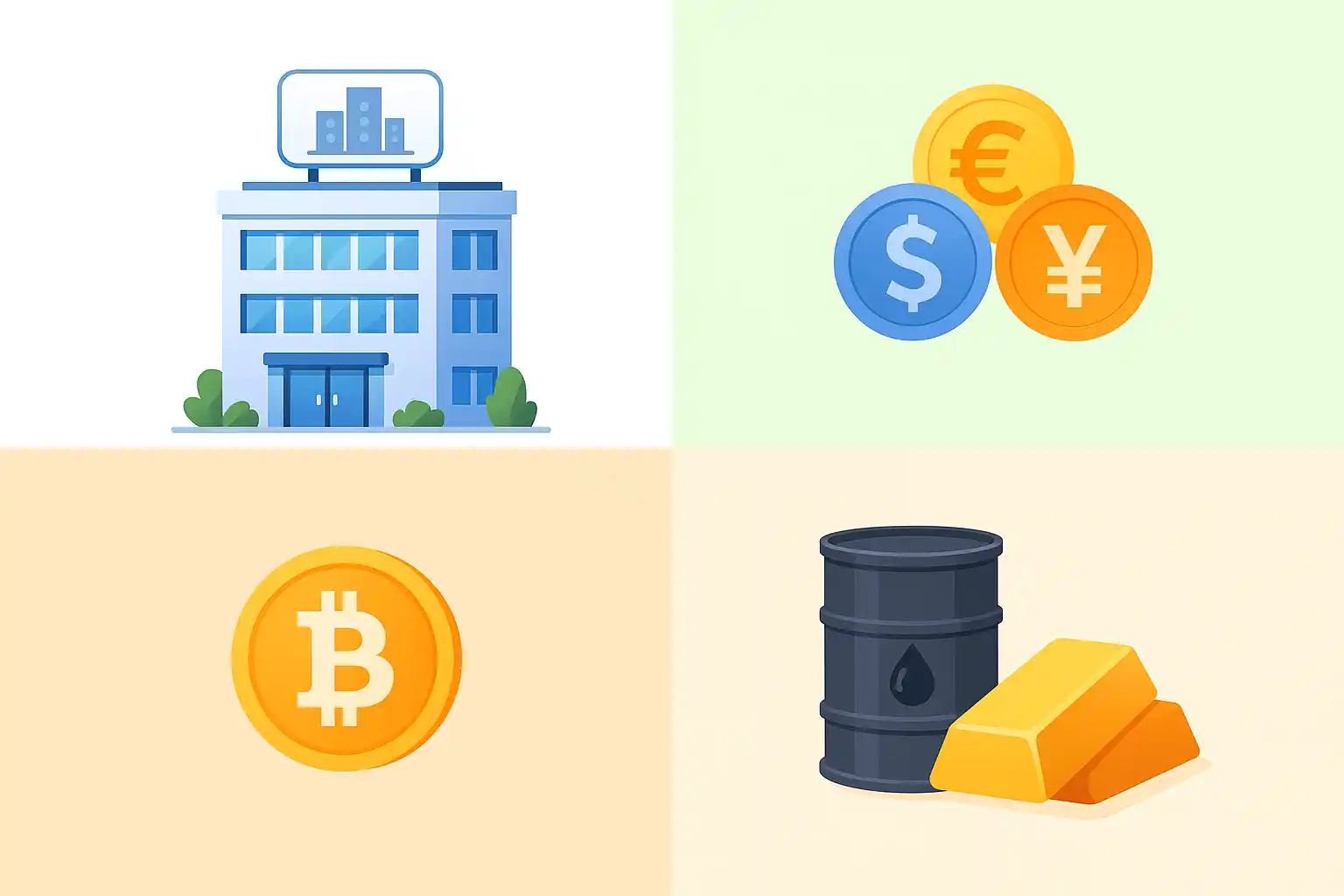
You do not invest in a vacuum. Stocks sit next to bonds, funds, forex, crypto, property and more.
Here is a simple comparison to ground you.
| Investment type | What you actually own | Main return source | Typical risk level* |
|---|---|---|---|
| Individual stocks | Piece of a company | Price gains and dividends | Medium to high |
| Stock funds / ETFs | Basket of many stocks | Diversified stock returns | Medium |
| Bonds | Loan to a government or company | Interest payments and principal | Lower than stocks usually |
| Forex | One currency vs another | Exchange rate changes | Medium to high |
| Crypto | Digital tokens or coins | Price changes only | High |
| Commodities | Exposure to raw materials, often via futures | Price changes only | Medium to high |
*Generalised view, actual risk depends on the specific asset.
Stocks vs bonds
We covered this briefly before. Stocks represent ownership and have historically offered higher returns over long periods, but with bigger ups and downs. Bonds are loans. They usually pay fixed interest and return principal at maturity, and bondholders stand ahead of stockholders if a company fails. Volatility is usually lower, but so is the expected long term return.
Most long term investors use a mix of both, not one or the other.
Stocks vs mutual funds and ETFs
A lot of mutual funds and ETFs are just bundles of stocks.
If you buy individual stocks :
- You decide exactly which companies to own
- You can concentrate in areas you like
- You also take on more risk from a single bad stock pick
If you buy stock funds or ETFs :
- You get instant diversification across many companies
- It is usually simpler for beginners and often cheaper than picking dozens of single names
- You give up a bit of control and potential for “home run” individual winners
Beginner guides from major investing sites often show that many new investors start with a low cost index fund, then later add individual stocks on top.
Stocks vs forex, crypto and commodities
If you are already trading forex or crypto, this part matters.
- Forex is trading one currency for another. You are not getting paid profits like a business owner, you are trying to profit from exchange rate moves. Leverage is common, which increases risk.
- Crypto is a broad space. Many coins do not produce cash flows. Returns depend mostly on supply, demand and narrative. It is volatile.
- Commodities like oil or gold are raw materials. They do not “grow” by themselves. You are again betting on price moves, often using futures contracts.
Stocks are different because you are owning productive assets, businesses that can grow earnings over time. That is why many diversified portfolios use stocks as the main growth engine, then add other assets to balance risk.
Benefits of Investing in Stocks
Let us be honest. If stocks did not have real benefits, nobody would bother riding out the volatility.
Some of the big plus points:
-
High potential long term returns
Over long periods, broad stock markets have historically delivered higher returns than cash or many types of bonds. Just remember, past performance is not a guarantee of future results. -
Ownership and participation in growth
When you own stocks, you are not just watching the economy, you are participating. If a company you like executes well, grows profits and builds something useful, you benefit. -
Dividend income and dividend growth
Strong companies that pay and grow dividends can help you fight inflation, because your income can rise over time, not stay fixed. -
Liquidity and flexibility
Public stocks can usually be bought and sold during market hours with a few clicks. That is different from, for example, real estate. -
Accessibility
Today you can open a brokerage account with low or zero commissions, fund it with a small amount and even buy fractional shares in large companies. You no longer need thousands just to get started. -
Diversification options
With thousands of stocks across different sectors, countries and styles, you can build something that fits your goals and tolerance for risk.
Risks of Stock Investing
Now the part that makes people nervous, and rightly so.
Stocks are powerful, but they are not safe in the way a savings account is safe.
-
Market volatility
Stock prices move up and down, sometimes a lot and sometimes fast. Even large, famous companies can have bad years. Regulators and education sites both stress this. -
Business risk
A single company can fail. If it goes bankrupt, bondholders and other creditors get paid before stockholders. Common shareholders at the end of the line may get nothing. -
No guarantees
Stocks do not promise a fixed return or principal protection. You only earn a return if price gains and dividends over time compensate you for the risk you take. -
Sequence of returns risk
If you are living off your portfolio and you hit a big market drop early in retirement, it hurts more than if it happens later. This is why retirement planning often adds more bonds and cash as you get older. -
Emotional and behavioral risk
Panic selling in crashes, FOMO buying at tops, overtrading, revenge trading after losses, all of these are human. They are also expensive. -
Liquidity and microcap risk
Thinly traded small stocks can be hard to exit without moving the price against you. -
Fraud and scams
Pump and dump schemes, fake tips, shady newsletters, social media hype and more. Regulators have entire sections warning about penny stock fraud and social media hype.
Disclaimer
Investing in stocks involves risk, including possible loss of principal. This guide is for educational purposes only and is not personalised investment advice.
If any of that sounds scary, that is normal. You do not remove these risks, but you can manage them, which we will get into.
How to Invest in Stocks (Step by Step)
Here is how to invest in stocks for beginners, without overcomplicating things.
Step 1: Decide if stocks fit your goals and risk tolerance
Before you open an account or pick a ticker, check in with yourself:
- How long can you leave the money invested? Years, not weeks, is ideal for stock investing.
- How do you react when you see red numbers?
- Are you comfortable with a 20 to 30 percent drop on paper, if you believe in the long term story?
Also ask yourself if you want to pick individual stocks, or if starting with broad funds makes more sense for you. Many beginner guides start here, with goals and risk.
Step 2: Choose a brokerage account
To buy stocks, you need a brokerage account.
Three broad types:
-
Discount or online brokers
Low fees, do it yourself platforms, geared to people who want control. -
Full service brokers
Higher fees, more personalised service, often with human advisors. -
App based brokers
Mobile first, often beginner friendly, sometimes with “social” features and fractional shares.
When you choose, pay attention to:
- Trading fees and account fees from stock brokers
- Platform ease of use and research tools
- Available account types in your country
- Order types, market access, customer support
Step 3: Open and fund your account
Opening an account is usually an online process:
- Fill out an application
- Provide ID and sometimes proof of address
- Answer a few questions about your experience and goals
Once approved, you link a bank account and move money in, often by bank transfer or card. Many brokers have no minimum deposit, or a low one such as 50 or 100 dollars.
It is also worth knowing:
- Some brokers offer tax advantaged accounts, for example retirement accounts.
- Many offer paper trading or demo accounts so you can practice with pretend money first, which is good for new traders who want to learn the platform without real risk.
Step 4: Build a simple starter plan
Before you hit “buy”, sketch a basic plan.
Two big questions:
-
Will you start with broad ETFs or mutual funds,
or go straight into individual stocks?
For many beginners, a simple index fund is an easy, diversified starting point. -
Will you invest all at once, or spread it out?
Lump sum means you put in your money right away.
Dollar cost averaging means you invest a fixed amount on a regular schedule, for example every month, which smooths out your entry price over time.
Dollar cost averaging does not guarantee profits or protect you from losses, but it can make the emotional side easier.
Step 5: Research stocks or funds
Now you decide what to actually buy.
Two big ways to look at investments:
-
Fundamental analysis
You study the business itself, its financial statements, earnings, cash flows, competitive position, valuation ratios like P/E and P/B, and so on. Many investor education sites cover this in depth. -
Technical
analysis
You focus on the chart, trends and patterns in price and volume, looking at things like moving averages, support and resistance areas and indicators such as RSI. This style is more common among active traders.
You can mix both. For example, you might use fundamental of stocks to pick strong companies and technicals to choose better entry points.
Step 6: Place your first trade
On your broker platform, placing a trade usually comes down to:
- Search the stock or fund by its ticker symbol.
- Choose buy or sell.
- Enter the number of shares, or a dollar amount if fractional shares are supported.
- Choose an order type.
The two main order types you will use at the beginning:
-
Market order
Buys or sells as soon as possible at the best available price. It gives you speed, but you do not control the exact price. -
Limit order
You set a maximum price you are willing to pay when buying, or a minimum price you are willing to accept when selling. The trade will only execute if the market reaches your limit.
You will also hear about the bid ask spread , which is the small gap between what buyers are currently offering and what sellers are asking. On liquid large cap stocks, spreads are usually tiny. On thinly traded names, they can be significant.
Step 7: Monitor, review and adjust
After you invest, the job is not to stare at your app every minute.
Instead:
- Check in on your portfolio on a sensible schedule, maybe monthly or quarterly.
- Compare your actual mix to your target mix, and rebalance if one part has grown too large.
- Review the fundamentals if you are a stock picker, or the strategy if you use funds.
Rebalancing is just bringing your investments back to your desired allocation, for example 70 percent stocks and 30 percent bonds.
And yes, there will be days when everything is red. Try not to make big decisions in a panic. Let the plan do the heavy lifting.
Stock Investing Strategies and Next Steps
Once you are comfortable with the basics, you can start thinking about stock investing strategies.
Stock investing tips for beginners
If you are just starting out, here are some simple habits that can save you pain:
- Start small. You do not have to go “all in” on day one.
- Focus on diversification instead of hunting for that one magic stock.
- Avoid putting too much in any single company or sector.
- Be skeptical of hot tips, social media hype and “guaranteed” strategies.
Your future self will probably thank you for being boring and consistent, not for swinging wildly at every new idea.
Fundamental vs technical analysis
We touched on this earlier, but let us recap the differences in plain language.
Fundamental analysis
- You are trying to understand what the business is worth.
- You look at financial statements, management quality, competitive advantages, industry trends and valuation ratios.
- This style fits investors who enjoy digging into numbers and stories, and who are willing to hold for years.
Technical analysis
- You are mainly studying price action and volume.
- You use charts and indicators to find trends, breakouts, reversals and so on.
- This style often suits more active traders who are comfortable making shorter term decisions and sticking to rules.
- Technical analysis for stock trading is popular amongst all investors.
There is no rule that you must pick one side. Many people mix them.
Overview of common strategies
Here is a quick feel for who different strategies fit:
-
Growth investing
You target companies with strong growth in revenue and earnings. You accept higher volatility for higher potential upside. -
Value investing
You look for companies that seem cheap. You are patient and accept that the market might take a while to “wake up”. -
Income or dividend investing
You focus on companies or funds that pay regular dividends. You care a lot about stability, payout ratios and balance sheets. -
Index or passive investing
You buy broad funds that track an index like the S&P 500 and hold for the long term. You are not trying to beat the market, you are trying to match it with low fees. -
Active trading styles (day, swing,
momentum)
You seek to profit from short term price moves. This takes more time, discipline and risk control, and is not required to be a successful investor.
You will also hear about ESG or socially responsible investing, where you choose companies based partly on environmental or social criteria. Whether you use that filter is up to your values.
Diversification and portfolio basics
Diversification just means not putting all your eggs in one basket.
You can diversify across:
- Many stocks instead of a few
- Different sectors and market caps
- Different asset classes, like stocks, bonds and cash
The exact mix of these pieces, usually called asset allocation , should match your goals and time horizon. Younger investors often hold more stocks. People closer to retirement often hold more bonds and cash to stabilise things.
For active traders, position sizing is also huge. Risking 1 or 2 percent of your account per trade is different from betting 20 percent on one idea.
If you want the math done quickly, the position size calculator turns a risk % into a share count.
Managing Risk and Emotions
A big part of successful stock investing is not about picking the perfect company. It is about not blowing yourself up.
Practical risk management tools
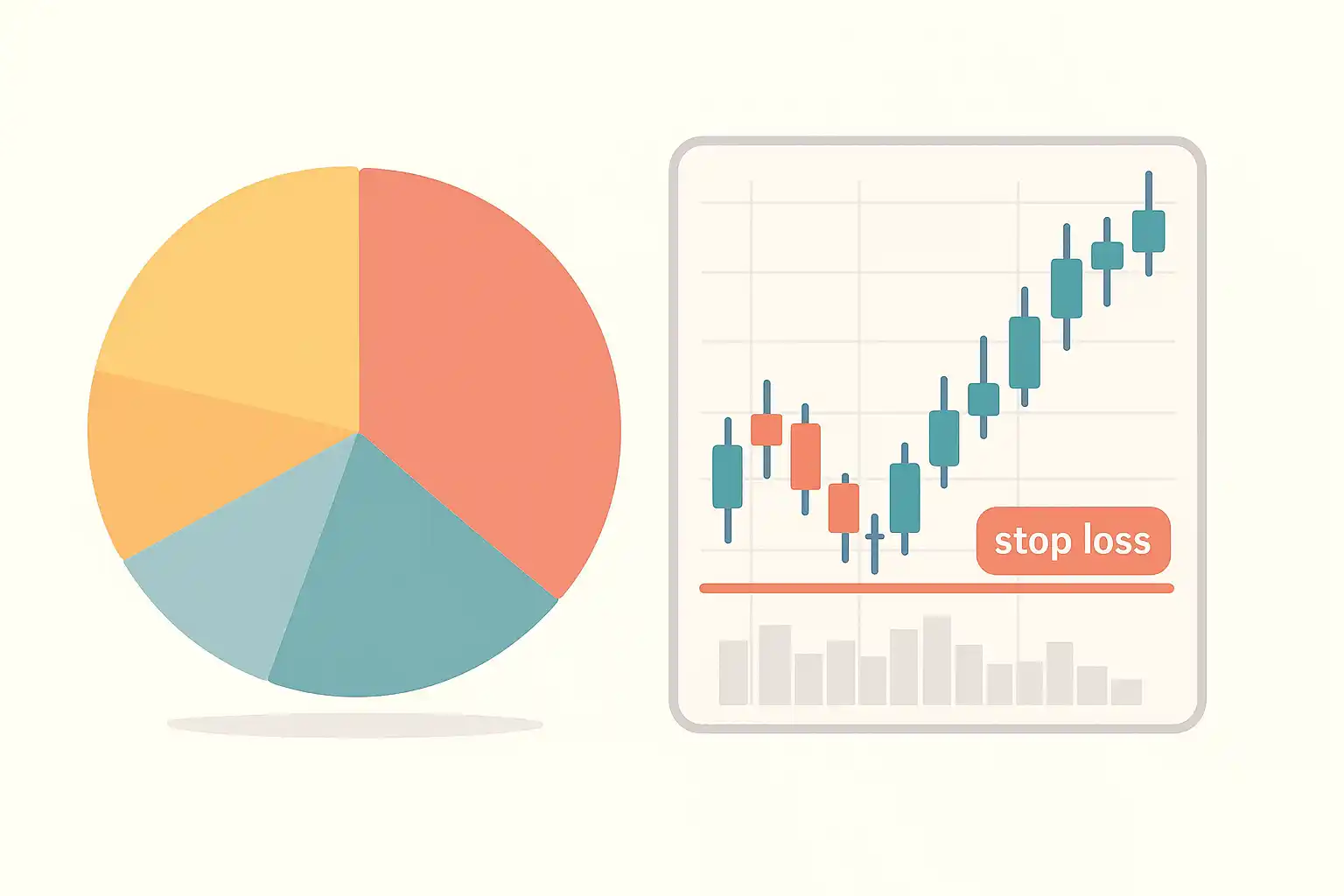
Some simple tools you can use:
-
Position sizing
Decide how much of your portfolio you are willing to put into any one stock. For example, you might limit single names to 5 percent each. -
Stop loss and take profit orders
You can pre set levels where your broker will sell if price falls to protect you, or sell if price rises to lock in gains. Just remember, gaps and fast moves can still make fills imperfect. -
Diversification
Spread your risk across sectors and asset classes, so one bad event does not sink everything at once.
None of these tools make risk disappear, but they keep it at a level you can live with.
Time horizon and volatility
If you need your money back in six months for rent or tuition, stocks are usually not the right tool.
Historically, the longer you stayed invested in a broad, diversified stock portfolio, the more the odds improved that you came out ahead, especially over 10 to 15 year periods. That does not mean there is a guarantee. It just means that volatility tends to even out over time with appropriate portfolio management.
If you know you can leave money invested for many years, daily or weekly ups and downs become less terrifying.
Common investor mistakes
Here are a few traps you want to avoid:
- Selling everything in a panic after a big drop, then buying back higher later.
- Chasing hot stocks after they have already exploded in price because everyone on social media is talking about them.
- Taking too much risk after a streak of wins, thinking you are invincible.
- Ignoring taxes, fees or diversification because they feel “boring”.
Most of us have done at least one of these at some point. The trick is to learn the lesson once, not repeat it every cycle.
Staying informed without overreacting
There is endless financial news out there. You want to be informed, not addicted.
A few ideas:
- Follow a small set of high quality sources, such as major broker and regulator education sites.
- Check markets at set times instead of every five minutes.
- Make decisions based on your written plan, not just on headlines.
Your goal is to be the calm person in the room when everyone else is freaking out.
FAQs About Stocks
Let's clear up some common questions quickly.
What are stocks in simple terms?
Stocks are small pieces of a company that you can buy. When you own a stock, you own a little part of that business and you share in its potential profits and losses.
How do stocks work?
Stocks trade on markets where buyers and sellers meet and agree on prices. Those prices move based on supply, demand and expectations about the company and the economy. You can make money from price rises and dividends, but you can also lose money if prices fall.
How do you make money from stocks?
You make money mainly in two ways, by selling shares for more than you paid and by collecting dividends. Some investors focus on growth stocks for bigger price moves, others focus on dividend stocks for steady income, and many use a mix.
Are stocks and shares the same thing?
In everyday language, yes. People use “stocks”, “shares” and “equities” to talk about ownership in companies. In some countries, “shares” is more common, in others “stock” is.
Are stocks safe for beginners?
Stocks are not “safe” in the sense of bank savings. Prices go up and down, and you can lose money. But if you use diversification, a long time horizon and sensible position sizes, they can be a useful tool for building wealth over the long run.
How much money do I need to start investing in stocks?
These days, you can start with small amounts, sometimes even a handful of dollars, thanks to fractional shares and zero commission brokers. Just remember that diversification improves as your account grows, so adding regularly over time is a good habit.
Can you lose more money than you invest in stocks?
If you buy stocks in a normal cash account, without margin, the worst case is that the stock goes to zero and you lose the money you put in. If you use margin, short selling or certain derivatives, you can lose more than your original investment, so beginners usually avoid those until they understand the risks.
Is it better to invest in stocks or ETFs?
ETFs give you instant diversification, which is great if you are starting out or do not want to research many companies. Individual stocks give you more control and potential upside, but also more risk. There is no “one size fits all” answer, many people hold both.
How long should I hold onto stocks?
That depends on your goals, but for most people, thinking in years not days helps a lot. Historically, holding diversified stock investments for 10 to 15 years has reduced the chance of loss compared with short holding periods, although there is never a guarantee.
What is the best time of day to trade stocks?
Active day traders often focus on the first and last hour of the trading day, when volume and volatility are higher. If you are a long term investor, the exact time of day usually matters much less than your overall strategy and risk management.
Where can I check stock prices in real time?
You can see quotes in your brokerage app, and also on financial sites and portals. For educational info and delayed prices, major finance portals and broker learning centers are good starting points.
Should beginners pick individual stocks or start with index funds?
If you are brand new, starting with a simple index fund or ETF is usually calmer and more diversified than jumping straight into individual stock picking. You can always add a “fun money” bucket later if you want to learn stock picking with a small part of your portfolio.
Deep stock-market guides
Deeper stock guides for specific strategies, analysis and tools.
FAQ
Frequently Asked Questions
What is a stock?
A stock is a share of ownership in a real company, so when you buy one you own a small slice of that business and share in its profits and losses. You may also get voting rights on some company decisions and a claim on assets if the business is wound up.
How do beginners start investing in stocks?
Open a brokerage account, fund it with money you can leave for years, and start with a broad index fund or ETF before picking individual stocks. I suggest adding regularly over time and keeping position sizes small while you learn.
How are stock returns taxed?
In most countries you owe tax on capital gains when you sell shares for a profit, and on dividends you receive, with lower long-term rates often applying if you hold for over a year. The exact rules vary by jurisdiction, so check the IRS rules in the US or HMRC rules in the UK, and consider a tax-advantaged account like an IRA or ISA.
What's the difference between stocks and ETFs?
An individual stock is ownership in one company, so its risk and return depend entirely on that business. An ETF is a single fund that holds a basket of many stocks (or other assets), giving you instant diversification in one trade, which is why beginners often start there.
Continue Learning
Explore more guides and enhance your trading knowledge.