If you have ever looked at your broker's app and thought, “What on earth is an ETF and do I need one”, you are in the right place.
ETFs have gone from a niche product traders whispered about, to the main building blocks in a lot of everyday portfolios. By the end of September 2025, global ETF assets hit around 18.8 trillion dollars, according to ETFGI , and there are over 4,300 ETFs in the US alone, with roughly 11.6 trillion dollars in assets, as reported by MarketWatch . That is not a fad, that is a full blown shift in how people invest.
This guide is here to be your “one stop shop” on ETFs, for both US and UK investors. No sales pitch, no product push, just straight education so you can make your own calls.
Why ETFs matter today
The ETF boom in numbers
If you feel like ETFs are everywhere now, you are not imagining it.
In 1993, the first US ETF launched. For a long time, ETFs were something mostly pros used. Then costs fell, online brokers got cheaper, and index investing took off.
Now, according to ETFGI, global ETF assets reached around 18.8 trillion dollars by the end of September 2025, a record high. The US slice of that is huge, MarketWatch reports over 4,300 ETFs and about 11.6 trillion dollars in assets.
Active ETFs, the ones where a manager is picking securities, are exploding too. Barron's notes that active ETF assets grew from roughly 81 billion dollars in 2019 to more than 600 billion by 2024, and the trend is still strong.
So what does that actually mean for you?
It means ETFs have moved from niche tools to being the backbone of a lot of portfolios, from tiny beginner accounts to big institutional money. If you understand ETFs, you understand the main toolkit modern investors use.
ETFs as a modern toolkit
Look at most long term portfolios today. You will usually find:
- A few broad stock ETFs
- A couple of bond ETFs
- Maybe some sector or factor ETFs for “tilts”
This ties into big trends you have probably heard about. Passive investing, low fee funds, “own the market instead of trying to beat it”.
Compared with traditional mutual funds, investors have been moving money into ETFs for years. The flows tell the story, and places like Barron's and the Financial Times have been writing about this “great ETF boom” and what it means.
For you, the practical point is simple. ETFs are now a primary way to get exposure to markets. So learning how they work is not “extra”. It is core investing knowledge.
What is an ETF, in plain English
Let's strip it right down and walk through some ETF investing basics .
Simple definition
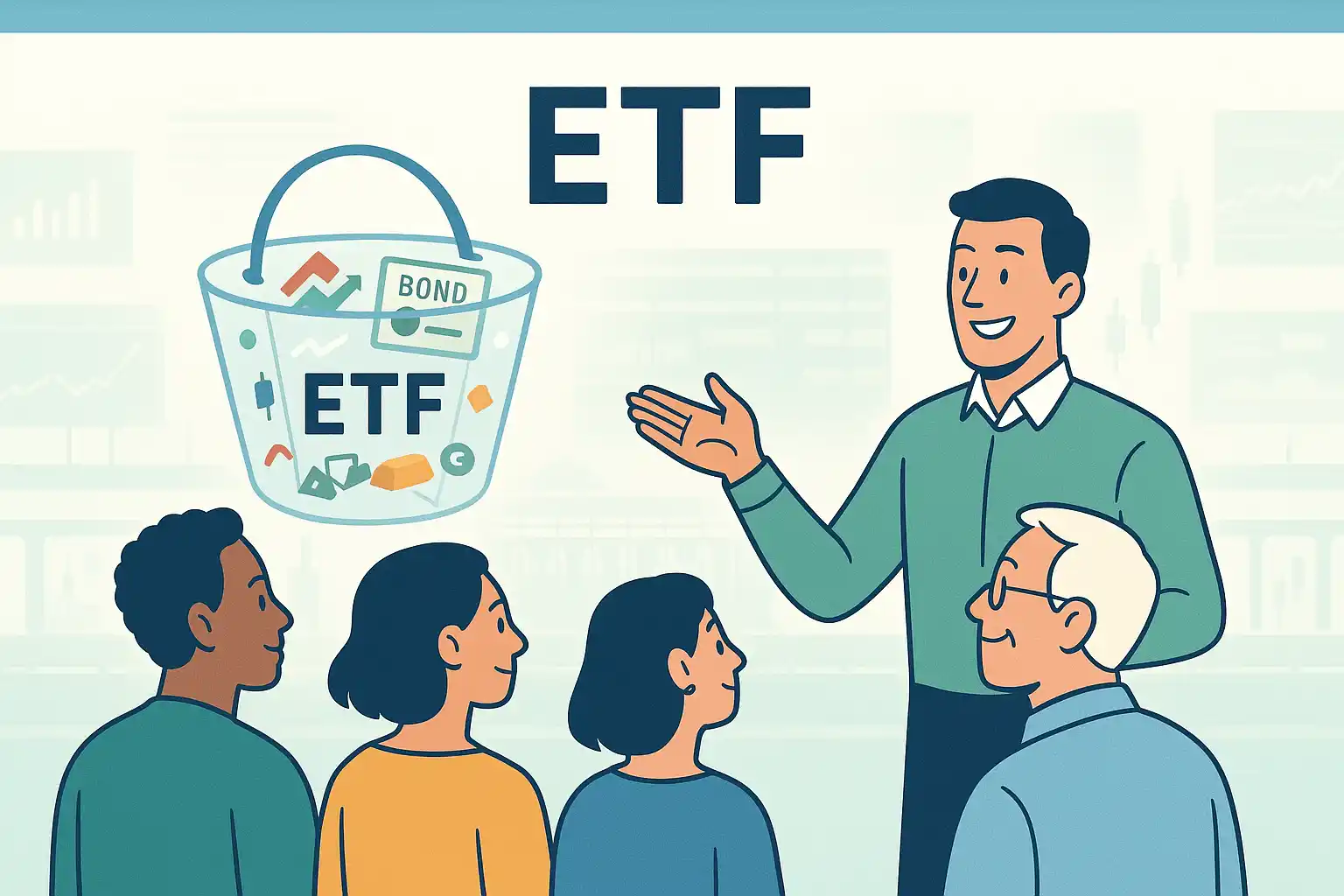
An ETF is a pooled investment fund . Your money goes into a big pot together with other investors. The fund then uses that pot to buy a basket of assets , for example:
- shares
- bonds
- commodities like gold
This pool is sliced up into shares of the ETF. Those shares are listed on a stock exchange and can be bought and sold during the trading day, just like a normal company share.
So when you buy one share of an ETF, you are basically buying a small slice of a bigger basket.
The acronym itself is boring but useful to remember:
ETF = Exchange Traded Fund
- Exchange, because it trades on a stock exchange
- Traded, because you can buy and sell it during the day
- Fund, because underneath it is a portfolio of assets
ETFs sit between mutual funds and stocks
Think of mutual funds on one side and individual shares on the other.
From mutual funds, ETFs borrow things like:
- Diversification, one fund holds many securities
- Professional management, someone is running the portfolio, even if it is just tracking an index
From shares, ETFs borrow:
- Intraday pricing, you see prices move during the day
- Market trading, you can use different order types and trade when markets are open
Quick real world examples
If you are in the US, an S&P 500 ETF is the classic example. The fund owns shares in the 500 large US companies that make up the S&P 500 index or something close to that set. When you buy one share of that ETF, you instantly spread your money across all those names.
If you are in the UK, you might see an ETF that tracks the FTSE 100, the 100 biggest companies on the London Stock Exchange, or a UCITS ETF tracking MSCI World which gives you global equity exposure in one hit.
The ETF itself is just a wrapper. The magic is in what it holds and how it tracks its target .
How ETFs work under the hood
Now, if you want to trust something with your money, it helps to know what is going on behind the scenes.
The main players in an ETF
There are a few different roles involved:
-
Fund sponsor or provider
This is the company that creates and manages the ETF, like Vanguard, iShares from BlackRock, or Fidelity. They design the fund, decide what index it tracks or what strategy it follows, and run the operations. You can see their explanations on their education pages, for example Fidelity's ETF guide or iShares' education section. -
Authorized participants (APs)
These are usually big banks or trading firms. They have a special relationship with the ETF provider and are allowed to create and redeem ETF shares directly with the fund, in large blocks. -
Market makers and the exchange
Market makers quote buy and sell prices for ETF shares on the exchange and keep trading smooth. The stock exchange is just the marketplace where you and everyone else trade those shares.
You as the investor sit at the edge of this system, using your broker to access the ETF shares.
What the ETF actually owns
Most ETFs are index funds . They try to copy an index, like the S&P 500, FTSE 100, MSCI World, a bond index, or a sector index. That is what people mean when they say “passive investing” or “index tracking”.
Some ETFs are actively managed . In those, a portfolio manager decides what to buy and sell, trying to beat an index instead of just matching it. As Barron's points out, this part of the ETF world is growing fast.
Inside the ETF, you can find:
- Equities, company shares
- Bonds, government or corporate
- Commodities, often via futures or sometimes physical holdings
- Cash and sometimes derivatives, used to fine tune exposure
When you read a fund factsheet from a provider like Vanguard, they show you the top holdings and the breakdown, so you can actually see what you own.
NAV vs market price
Two prices matter with an ETF.
First is NAV , Net Asset Value, which is basically:
Value of all the assets in the fund, minus any liabilities, divided by the number of shares.
This is usually calculated once per day. Providers like Vanguard and Investor.gov both explain NAV in this way.
Second is the market price , which is the price you see on your broker app during the day. That price moves around based on supply and demand, just like any other share.
For liquid, popular ETFs, the market price usually stays close to NAV. The reason is arbitrage, which sounds fancy but is just traders stepping in when the gap is big enough to make a profit.
If the ETF price drifts above NAV, APs can create new shares cheaply by delivering the underlying securities to the fund and then sell those shares in the market. That extra supply tends to push the price back toward NAV.
If the ETF price falls below NAV, APs can buy the cheap shares in the market, redeem them with the fund, and take the underlying securities, shrinking the number of shares and pulling the price back up.
You do not have to do any of this yourself, but it is good to know that this mechanism exists and why ETFs usually trade close to the value of what they hold.
The creation and redemption process, in simple steps
At a high level, here is what happens:
- An AP assembles the right basket of securities that matches the ETF's portfolio.
- They deliver that basket to the ETF provider.
- The ETF provider gives them a big block of ETF shares in return.
That is creation .
For redemption :
- The AP delivers a block of ETF shares to the provider.
- The provider gives them the underlying securities back.
In the US, this “in kind” process can help the ETF avoid selling stuff inside the fund when investors leave, which is part of why providers like Fidelity highlight the tax efficiency of ETFs compared with mutual funds.
Trading ETFs during the day
For you, trading an ETF feels similar to trading a stock.
You can:
- Place a market order , which fills at the current best price.
- Use a limit order , where you set the maximum you will pay or the minimum you will accept.
- In some cases, use stop or stop limit orders, if your broker supports them.
Guides from Vanguard and Charles Schwab talk through this, and brokers often encourage using limit orders for ETFs, especially for less liquid ones.
In the US, most major platforms now offer zero commission trading on ETFs, so your main explicit cost is the spread , the small gap between the buy and sell price.
Tracking error and premiums and discounts
Two slightly nerdier things you will see in ETF discussions are tracking error and premiums/discounts .
- Tracking error is how much the ETF performance differs from the index it is trying to follow. Fees, trading costs, sampling methods, all create small gaps.
- A premium means the ETF is trading a bit above NAV. A discount means it is trading below.
Regulators and educators, like Investor.gov and Vanguard, cover these concepts and stress that big, broad ETFs usually have small tracking error and tiny premiums or discounts. But once you go into niche, illiquid or leveraged ETFs, this can matter more to you.
If you are just starting out, do not stress too much about the tiny decimals, but be aware that these things exist and that you can look them up on a fund's site.
Types of ETFs you will run into
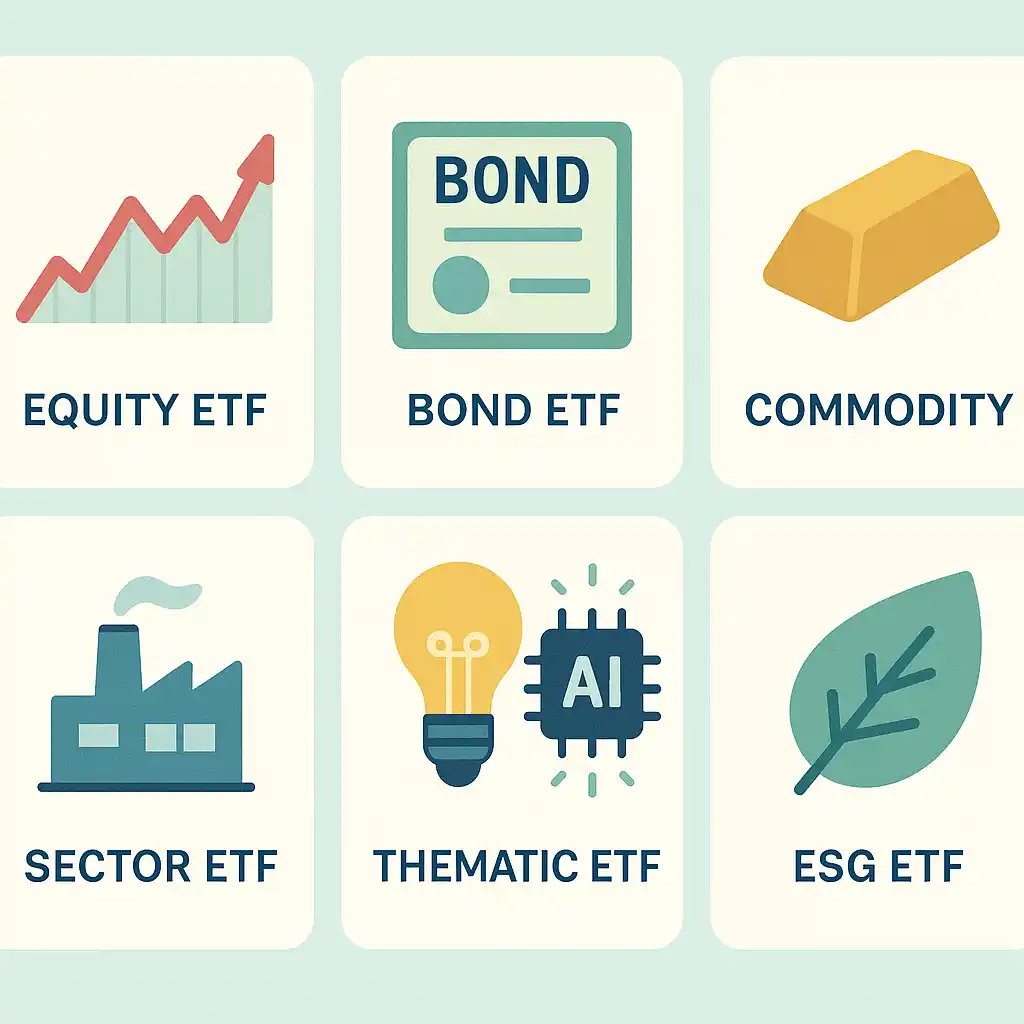
The ETF universe is huge, but you can think of the different types of ETFs as a menu with a few big sections. For ticker-level coverage, start with our ETF fact sheets hub.
Equity ETFs
These hold shares in companies.
You get:
- Broad market ETFs, covering whole markets like the total US stock market, the S&P 500, the FTSE 100, or global indexes like MSCI World.
- Style or size ETFs, which tilt toward growth or value, or focus on small caps or mid caps.
- Sector ETFs, focusing on one industry like technology, healthcare, financials, and so on.
NerdWallet uses similar groupings when they teach ETF types, because this is how most platforms lay things out.
If you are a beginner , broad market equity ETFs are often where people start, because they give wide exposure in a single holding. Our US equity ETF hub is a practical place to compare the core options.
Bond (fixed income) ETFs
These hold different kinds of bonds:
- Government bonds, like US Treasuries or UK gilts
- Investment grade corporate bonds
- High yield bonds
- Municipal bonds in the US
- Inflation linked bonds
You can also pick duration, short, intermediate, or long term funds, which affects how sensitive the ETF is to interest rate moves.
As Fidelity explains, a key point with bond ETFs is that, unlike an individual bond that matures on a set date, the ETF keeps rolling its holdings. So you do not have one fixed maturity date, you have ongoing exposure to that part of the bond market.
If you are focused on income or more stability, bond ETFs can play a big role, and our bond ETF hub helps you compare common choices.
Commodity and precious metal ETFs
These are the “gold” and “oil” type ETFs you see.
They can be:
- Physical, where the fund actually holds the metal, common with gold
- Futures based, where the fund uses futures contracts to gain exposure to commodity prices
iShares and other providers explain the difference, and it matters because futures based funds have extra moving parts, like “roll yield”.
If you ever wondered how to get gold exposure without storing coins under your bed, this is usually how people do it.
International and emerging market ETFs
These give you exposure outside your home market. You can browse examples in our international ETF hub .
You have:
- Developed markets ex US or ex UK
- Region specific funds, like Europe, Asia Pacific
- Single country funds, like Japan, India etc
With these, you have to think about currency risk and political or regulatory risk. Emerging markets, for example, can be more volatile and have different rules.
Factor and “smart beta” ETFs
These ETFs tilt the portfolio based on certain traits, called factors. Common ones are value, quality, momentum, and low volatility .
Instead of just owning the whole market by size, these funds overweight stocks with these characteristics.
They sit in between totally passive and fully active. Providers like iShares and Charles Schwab group these as “smart beta” or “strategic beta” funds.
If you are more advanced, factors might appeal to you. If you are a beginner, treat them as optional add ons, not the core.
ESG and sustainable ETFs
These use Environmental, Social and Governance screens in different ways. They might:
- Exclude certain industries
- Pick “best in class” companies
- Focus on specific themes like clean energy
The details vary a lot in this space, so if you care about ESG, you want to read the methodology section on the fund page, not just the marketing label.
Dividend and income focused ETFs
These ETFs aim to pay out regular income, often by holding high dividend stocks, dividend growth stocks, bonds, or a blend.
They can be useful if you want regular cash flow, but you still need to watch:
- Yield vs risk, higher yield usually means higher risk
- Whether the dividend is sustainable over time
The marketing often looks attractive here, so if you are income focused, keep your analytical hat on.
Thematic and sector tilt ETFs
This is where you see the fashionable stuff.
ETFs based on:
- AI and robotics
- Cybersecurity
- Clean energy
- Space
- And many other themes
These can be exciting, and they can also be concentrated and volatile. You are basically making a bet on a narrow part of the market, which is why we break out examples in the sector ETF hub .
They can make sense as small “satellites” around a boring core, not as your entire portfolio.
Leveraged and inverse ETFs
These are the danger zone for most beginners.
Leveraged ETFs aim to give you 2x or 3x the daily return of an index. Inverse ETFs aim to move in the opposite direction, also usually on a daily basis. We cover both in separate leveraged ETF and inverse ETF hubs.
As BlackRock's iShares materials and regulators like Investor.gov keep repeating, daily resetting and compounding make these behave differently over longer periods. They are mainly for short term trading, not long term holding.
If you are a beginner or you invest for the long term, you can happily ignore leveraged and inverse ETFs for now. There is no rush.
Active ETFs
These are ETFs where a manager is actively picking securities. They combine an active strategy with the ETF wrapper.
According to Barron's, active ETF assets have grown fast, but a small number of funds dominate flows.
For you, the question is simple. Are you paying a higher fee for an active strategy, and does it fit with how you want to invest, or are you mainly looking for low fee index exposure.
Physical vs synthetic ETFs
Finally, some ETFs are physical , owning the underlying securities directly. Others are synthetic , using swaps or other derivatives with a bank to get the performance of the index.
Synthetic structures are more common in some European markets and can introduce counterparty risk, which means you are exposed to the bank as well as the market.
Regulators like Investor.gov highlight this, and providers usually explain whether a fund is physical or synthetic on the factsheet.
If you are not sure, check the “replication method” in the documentation.
Benefits of ETFs, why investors like them
Let's flip to the positive side for a moment and be honest about why ETFs have become so popular.
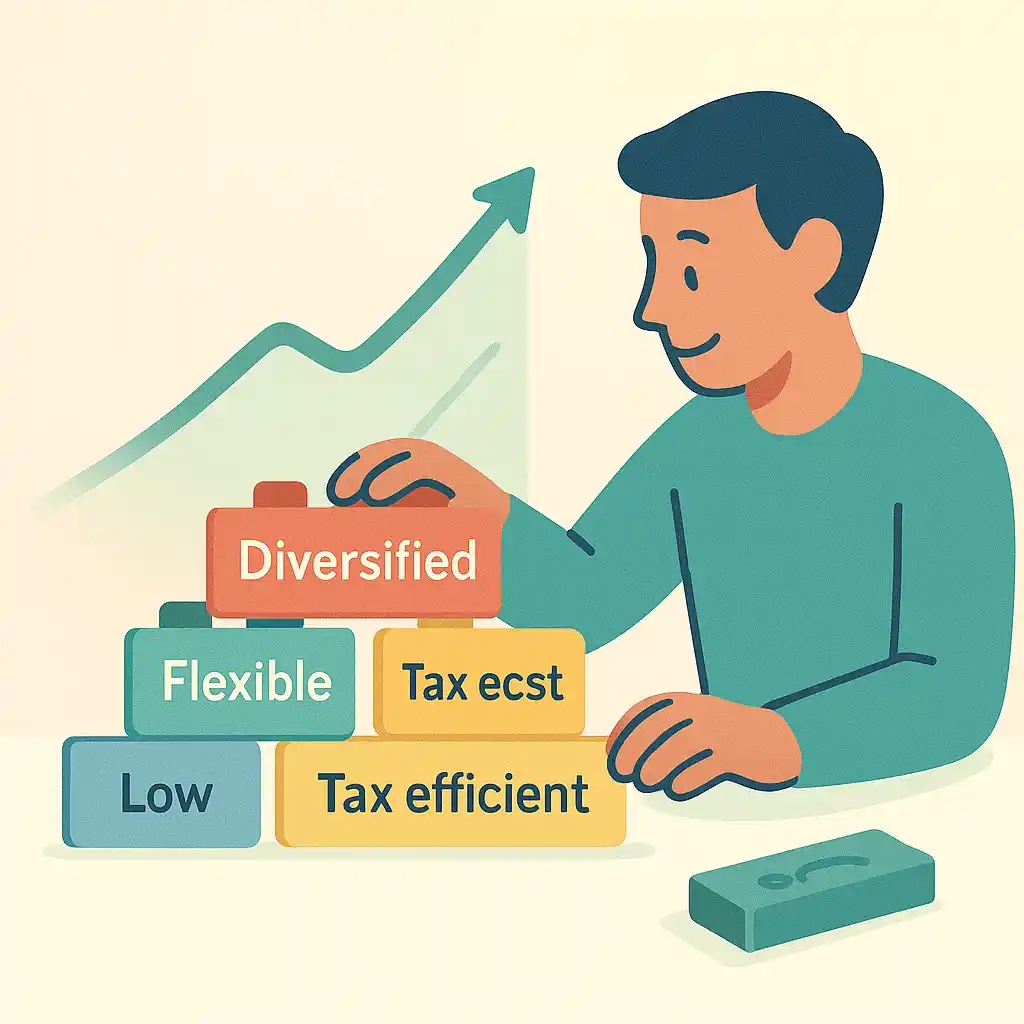
Diversification in a single trade
With one ETF, you can own dozens or even thousands of securities. That means if one company blows up, it does not blow up your entire portfolio.
Providers like Vanguard highlight this as one of the main selling points, and they are right. If you are a beginner, getting rid of single stock risk is a big deal.
Low ongoing costs
A lot of broad index ETFs charge low fees. It is common to see annual expense ratios under 0.10 percent, and some core US equity ETFs sit around 0.03 percent.
Guides from Fidelity and others show comparisons between ETF fees and traditional active mutual fund fees. Over decades, .
If you are cost conscious, ETFs are handy tools.
Trading flexibility and liquidity
Because ETFs trade like stocks, you can buy and sell them during market hours. You can use different order types, you can see real time prices, and in many markets you can even short sell or use margin, if that fits your risk appetite.
Just remember, flexibility cuts both ways. It is great for control, but it can also tempt you into overtrading.
Transparency
Many ETFs publish their full holdings every day. So you are not guessing what is inside, you can look at the actual list.
iShares, Vanguard, and others all offer daily holdings downloads.
If you are the kind of person who likes to know exactly what you own, this is a nice feature.
Tax efficiency, mainly in the US
In the US, the “in kind” creation and redemption process that we talked about earlier can help ETFs reduce capital gains distributions. That means you often only realise capital gains when you sell your ETF shares, not when someone else exits the fund.
Fidelity and Charles Schwab both call this out as a big benefit of ETF structures in taxable accounts.
This is a US specific design feature though. If you are in the UK or Europe, you need to look at local tax rules and wrappers like ISAs and SIPPs.
Low minimums and easy access
You can start with the price of one share, or even less if your broker offers fractional shares. You do not need thousands to get proper diversification.
That is one of the reasons ETF content from Fidelity and NerdWallet often targets beginners. ETFs are simply more accessible than some older investment products.
Professional management, simple for you
Whether the ETF is passive or active, there is a team running it. They handle:
- Rebalancing
- Index changes
- Corporate actions
You do not need to track every single company or bond. You can focus on the bigger decisions, like how much you want in stocks versus bonds.
If you are not looking to spend your evenings reading balance sheets, this simplicity is a big plus.
Risks and downsides of ETFs

I like ETFs a lot as tools, but they are not magic. So we need to talk about the real risks too.
Market and sector risk
If the market goes down, your ETF that tracks that market will also go down. Diversification reduces single company risk, not overall market risk.
Sites like Investor.gov make this point clearly. You can still lose money, sometimes a lot, especially in stock heavy ETFs.
If you buy a sector ETF, like technology or energy, you are also taking sector specific risk. If that sector has a rough year, your ETF will feel it.
Tracking error
No ETF tracks its index perfectly. There are frictions, fees, sometimes sampling instead of full replication.
The difference between the ETF's returns and the index is called tracking error. With broad, plain vanilla ETFs, it is usually small. With more exotic funds, it can be larger.
If you are picky, you can check historical tracking on provider sites and data tools. If you are a beginner, just know that there is a small gap and that lower fee and better run funds usually track more tightly.
Liquidity and bid ask spreads
Not all ETFs trade the same way.
Popular, big funds usually have tight spreads, meaning the difference between the buy and sell price is small. Less popular or more complex ETFs can have wider spreads.
Guides from Fidelity and Charles Schwab talk about liquidity, and they are right to. If you trade a thin ETF, your transaction cost can be higher, even if the headline fee looks low.
Premium and discount to NAV
During normal conditions, big equity ETFs trade close to NAV. In stressed markets, or in bond or international ETFs, premiums and discounts can widen.
This is exactly why Investor.gov warns investors to look at premium or discount data, which ETF sites usually show.
If you place a market order in the middle of a messy day, you might get a price that is not ideal compared with NAV. For larger trades, people often use limit orders or even work with trading desks, but as a retail investor, at least try to avoid obviously bad times, like right at the open in a volatile market.
Fund closure risk
ETFs can close if they stay small and unprofitable for the provider. When that happens, the fund usually sells or distributes the holdings and returns you the value, but there can be:
- Trading disruption
- Taxable gains
- Hassle choosing a replacement
NerdWallet mentions fund closures as a real but manageable risk. The simplest way to reduce it is to avoid tiny, obscure ETFs if you plan to hold for years.
Complexity and leverage risks
Leveraged, inverse, options based, and synthetic ETFs can behave in ways that surprise you. Daily resetting, path dependence, counterparty risk, all the fun stuff.
This is why providers like iShares and regulators keep adding “for sophisticated investors only” type language in their materials.
If you are still learning, you do not need these products. Focus on plain, fully backed index funds first.
Behavioural risks
Honestly, a big risk is not the ETF itself, it is how we behave.
Because ETFs are easy to trade, you might be tempted to constantly jump from one hot theme to another, or sell at the worst possible moment during a downturn.
You see a list of top performing ETFs and think, “I want that one”, without noticing that the performance was in the past and the risk has gone up.
If you recognise yourself in that, you are normal. The trick is to build rules for yourself and stick to them, instead of letting the app notifications drive your decisions.
ETFs vs other investments
When you look at ETFs in isolation, they seem great. But the real question in your head is usually, “Compared to what”. Stocks, mutual funds, index funds, ETNs, there is a lot going on. Let's break it down in a way that helps you choose.
ETFs vs mutual funds
ETFs and mutual funds are cousins. Both are pooled funds, both give you diversification, and in both cases a professional team is running the portfolio in the background.
The big differences are around how you buy and sell, what it costs, and how taxes can work.
With a mutual fund , you:
- Trade at the end of the day
- Always get the end of day NAV price
- Often set up regular monthly contributions through your broker or pension plan
With an ETF , you:
- Trade during market hours, like a share
- Use intraday prices, which move up and down during the session
- Place orders through your brokerage account
ETFs often have lower ongoing expense ratios than traditional active mutual funds. Mutual funds can also have things like sales loads, which are extra fees layered on top.
On the tax side, in the US, ETFs usually have an edge in taxable accounts, thanks to that creation and redemption process we talked about. They tend to distribute fewer capital gains than active mutual funds, which is why providers like Fidelity lean on that benefit.
One more practical point. Mutual funds are still heavily used inside workplace retirement plans. If your 401(k) offers index mutual funds with rock bottom fees, they can sit nicely alongside ETFs in a separate brokerage account.
If you are in the UK, mutual funds are often called unit trusts or OEICs . The idea is similar, pooled funds, end of day pricing, sometimes higher fees than the broad ETFs you can buy on the London Stock Exchange.
ETFs vs index funds
Here is a subtle one that confuses a lot of people.
An “index fund” is just a fund that tracks an index. It can be wrapped as a mutual fund or as an ETF .
So you can have:
- An S&P 500 index mutual fund
- An S&P 500 index ETF
Same basic goal, track the S&P 500, different wrapper.
Differences that matter to you:
- ETFs trade during the day, index mutual funds trade once per day
- ETFs can have smaller minimums, just the price of one share, mutual funds sometimes have higher minimum investments
- Tax treatment in the US, ETFs usually more tax efficient in taxable accounts, and mutual funds are often easier to automate inside retirement plans
So you do not choose “ETF or index fund”. You choose between an ETF index fund and a mutual fund index fund. And in many cases, both are fine, it depends on the account and your broker.
ETFs vs individual stocks
This one is more emotional. Stock picking is fun. ETFs are kind of boring. But boring is often what grows the money over time.
With individual stocks:
- You can hit big winners
- You can also blow up capital in one bad decision
- You need to research each company and stay on top of news
With ETFs:
- You spread risk across many companies in one go
- A single bad company has a tiny impact on your overall return
- You are tracking a market, sector, or theme, not trying to pick one hero
So if you are a learner or you do not want to live inside company reports, ETFs can be your “core”, and you can still have a small “fun” sleeve of individual stocks on the side if you enjoy that.
ETFs vs ETNs and other ETPs
You might also see the term ETP , exchange traded product. This is a catch all label that includes:
- ETFs, which own portfolios of assets
- ETNs, exchange traded notes
- Some commodity products
An ETN is different. It is a debt instrument, basically an IOU from the issuing bank that promises to pay you the return of an index. You do not own the underlying assets, you hold a note, so you take credit risk on the issuer as well.
This is exactly the risk that Investor.gov warns about in their ETN material. If the issuer has serious trouble, that is your problem too.
So when you see “exchange traded product”, pause and check which type it is. ETF and ETN are not the same thing, even if they trade on the same screen.
ETF costs, fees and taxes
Even small fees matter over a long investing life. So it is worth knowing exactly what you are paying when you buy an ETF and how ETF taxes, fees and risks fit together.
Expense ratio
The expense ratio is the annual fee charged by the fund. It is expressed as a percentage of the assets, and it is taken from the fund, not charged as a separate bill.
For example, an expense ratio of 0.10 percent means you pay 10 dollars a year for each 10,000 dollars invested.
You can find the expense ratio on:
- The ETF factsheet
- The provider website, like on Vanguard's ETF pages
- Many broker research tools
Broad, vanilla ETFs often have low expense ratios. More niche or active ETFs usually cost more. Fidelity explains this clearly, and they show how small differences compound over time.
If you are building a long term portfolio, picking low cost core ETFs can literally save you thousands over decades.
Trading costs
There are a few bits here.
First, the bid ask spread , the gap between what buyers are willing to pay and sellers are willing to accept. With big liquid ETFs the spread can be a penny, with smaller or exotic ETFs it can be much wider. That spread is an implicit cost to you.
Second, commissions . In the US, most major brokers now offer zero commission ETF trading, as Charles Schwab likes to highlight in their education material. In other markets, or with some older platforms, you may still pay a fee per trade.
If you are outside the US, especially in the UK or Europe, assume there might be a platform fee or dealing charge. Check your broker fee schedule, do not guess.
Third, some brokers charge platform fees based on your total assets, which apply regardless of whether you use ETFs or funds.
A simple rule for you. If you trade a lot, spreads and commissions matter more. If you buy and hold, expense ratios matter more.
Premiums and discounts to NAV
We already touched this, but from a cost point of view, if you buy at a big premium and later sell at a discount, you take a hit.
You can usually see premium or discount data on the ETF provider site or on research tools. Investor.gov calls out this risk especially for bond and international ETFs in stressed markets.
With big, mainstream funds, the premium or discount is usually tiny and not worth losing sleep over. With niche or illiquid stuff, it can be one more thing to sanity check.
US tax basics
Quick and high level only here, and if you are unsure you should talk to a tax pro.
For a US investor, you generally face:
- Capital gains tax when you sell your ETF for more than you paid
- Tax on dividends and interest that the ETF distributes, unless you hold it in a tax advantaged account
Because of the way ETFs handle creations and redemptions, they tend to distribute fewer capital gains than active mutual funds. This is one reason providers like Fidelity and Charles Schwab position ETFs as tax efficient tools in taxable accounts.
If you hold ETFs in accounts like IRAs or 401(k)s, tax rules are different again. The account wrapper often matters more than the product type inside.
The only safe blanket advice here is, do not base tax decisions on a quick internet article. Use articles to learn the concepts, then confirm with a professional.
UK and other markets tax basics
If you are a UK investor, the picture is different.
You might:
- Pay capital gains tax when you sell outside tax sheltered accounts
- Pay income tax on dividends
- Use tax wrappers like ISAs and SIPPs to shelter returns
Many ETFs available to UK and European investors are UCITS funds, often domiciled in Ireland or Luxembourg. That can affect how withholding tax works and how income is treated.
Again, the exact numbers and rules change, so the safest route is to learn the basics here, then check local guidance or speak to an adviser.
Keeping costs and taxes under control
You do not have to be a tax wizard to do a decent job here. A few simple habits go a long way:
- Prefer broad, low fee ETFs for your core holdings
- Avoid trading in and out all the time
- Use tax advantaged accounts where you can
- Be cautious with high turnover active or leveraged ETFs in taxable accounts
You will not optimise every last basis point, but you will avoid the big obvious mistakes.
How to invest in ETFs, step by step
If you are thinking, “Alright, I get the idea, what do I actually do next”, this bit is for you.
Step 1 - clarify your goals and time horizon
Start with why.
Are you investing for:
- Retirement that is 20 plus years away
- A house deposit in 5 to 10 years
- Just learning with a small amount
Your time horizon and your comfort with volatility will drive how much risk makes sense.
If you are a beginner, it can help to literally write down your goal, your time horizon, and how you reacted the last time markets fell hard. Be honest with yourself, this is not a test, it is to protect you from yourself later.
Step 2 - choose the right account and platform
Next, you need a place to hold your ETFs.
For a US investor, this usually means:
- A brokerage account, for taxable investing
- Retirement accounts like IRAs and 401(k)s, where you might use ETFs, mutual funds, or both
For a UK investor, common options are:
- A general investment account
- An ISA or SIPP with a broker or platform
Whichever platform you choose, check:
- Fees, trading commissions, platform charges
- Selection of ETFs, especially core broad funds
- Usability and basic tools, you do not need fancy stuff, but it is nice if the website is not from 1998
You can use reviews and comparison tools to shortlist, but remember, this page is not endorsing any particular broker.
Step 3 - build a shortlist of ETFs
Now the fun part. Picking actual tickers.
Here is a simple way to think about it, much in line with what Fidelity and others recommend.
-
Decide on your
asset allocation
, for example how much in stocks vs bonds.
- More years ahead and higher risk tolerance, more stocks
- Closer to your goal or more cautious, more bonds
-
For each major bucket, pick a
core ETF
, or maybe two.
- For stocks, that might be a global equity ETF or a US plus international pair
- For bonds, that might be a total bond market ETF or a mix of government and corporate
-
Apply a simple screen:
- Low expense ratio
- Reasonable fund size
- Decent trading volume
- Reputable provider, Vanguard, iShares, Fidelity and similar names are not perfect, but they are large and heavily watched
Write down two or three options for each role. You are not building a zoo. You are just trying to find solid building blocks.
Step 4 - place your first trade
Once you have picked, you need to actually buy the ETF through your platform.
A few practical tips, which echo guidance from Vanguard and Charles Schwab:
- For liquid, big ETFs, a market order for a modest amount is usually fine
- For less liquid ETFs, consider a limit order , where you set the maximum price you are willing to pay
- Try to avoid trading right at the open or right before the close, spreads can be wider then
If this is your first ETF purchase, it is totally fine to do a small “test trade”, just to get comfortable with how the platform works. This is not investment advice, just a sanity move so a click mistake does not hurt too much.
Step 5 - monitor and rebalance
After you are invested, your job is mostly about staying the course and adjusting when things drift.
- Check in maybe once or twice a year
- Compare your current allocation with your target
- If something has grown a lot and is now overweight, you can rebalance by trimming it a bit and topping up the underweight side

Common beginner mistakes to avoid
A few traps you want to sidestep:
- Chasing the highest performing ETF list from last year
- Going all in on a narrow theme, like AI, with no core diversification
- Ignoring costs, buying fancy expensive ETFs when a simple low fee fund would do
- Forgetting about taxes and trading like you are in a tax free bubble
If you keep your plan simple and repeatable, you are already ahead of a lot of people who just jump from idea to idea.
How to choose the right ETF, research in practice
Once you have a shortlist, you can do a bit more digging with some structured ETF analysis and research. This is where you can nerd out a little, but you do not have to overcomplicate it.
Start with your objective
Ask yourself, what job is this ETF supposed to do.
- Growth over the long term
- Income now
- Capital preservation
- A specific tilt, like more small caps or more quality
If the ETF does not clearly match a job in your portfolio, that is a red flag. You are not trying to collect logos, you are building a tool kit.
Understand the index or strategy
Read what index it tracks or, if it is active, what the manager is actually trying to do.
Indexes usually have a factsheet. It will tell you:
- What securities it includes
- How it weights them
- How often it rebalances
If it is an active ETF, look for the stated mandate and flexibility. Is the manager allowed to hold a lot of cash, go outside the benchmark, use derivatives.
This is the kind of detail providers like Fidelity and iShares encourage you to read, and they are not wrong.
Key metrics to check
A simple checklist for you:
- Expense ratio, and any other recurring costs mentioned
- Assets under management (AUM), is the fund big and established or small
- Average daily trading volume, tells you a bit about liquidity
- Tracking difference, how much historical performance lags the index
- Distribution yield, and whether it looks sensible for the assets held
If the yield looks too good to be true, or the tracking has been terrible, dig deeper before you click buy.
Portfolio characteristics
Next, look under the hood.
- Top holdings, do they make sense for the label on the fund
- Sector or country breakdowns, are you comfortable with the concentrations
- Market cap exposure, large, mid, small
If you already hold other funds or stocks, check whether you are just doubling up the same exposure.
Structure and risks
This is where things like physical vs synthetic replication, derivatives usage, and fund domicile come in.
Regulators like Investor.gov want you to know these details, especially for more complex funds.
Quick questions you can ask:
- Does the fund own the securities directly, or use swaps
- Does it lend securities, and what happens to the income from that
- Where is the fund domiciled, US, Ireland, Luxembourg, or elsewhere
You will find this in the prospectus and the Key Investor Information Document.
Tools and data sources
You do not need expensive tools to do basic ETF research.
You can use:
- ETF provider websites, like Vanguard, iShares, Fidelity
- Regulator sites like Investor.gov for unbiased education
- Your broker's basic screeners and comparison tools
If you remember one thing here, let it be this, always read at least the factsheet before you buy. It is a five minute job that can save you from owning something that is totally different to what you thought.
Alright, let's get the whole thing done properly this time.
ETF strategies and portfolio construction
Once you understand what ETFs are, the next level is how to actually put them together into a portfolio that fits your life, using straightforward ETF investing strategies. You are not trying to create the perfect spreadsheet. You are trying to create something you can live with through good markets and ugly ones.
Core index ETF portfolio
Think of your portfolio like a house. The core ETFs are the foundations and walls. Everything else is interior design.
For most people, that core is a mix of:
- One or two broad equity ETFs
- One or two broad bond ETFs
For example, a classic setup might be:
- A global stock ETF or a US plus international pair
- A diversified bond ETF, maybe a total bond market or a mix of government and high quality corporate
You will sometimes hear about a 60/40 portfolio, 60 percent stocks and 40 percent bonds. That is not magic, it is just a long standing rough template. You might be 80/20 if you are young and comfortable with risk, or 40/60 if you are closer to retirement and want more stability. The percentages are less important than the logic.
The nice thing with ETFs is you can express that allocation with just a handful of funds. You do not need dozens of tickers to be diversified.
Core satellite approach
If you are a bit more active, you might like the core satellite idea.
Here is how it works:
- The core is still those boring, low fee, broad ETFs that do most of the heavy lifting
- The satellites are smaller positions that tilt your portfolio toward something you care about, like a sector, a factor, or a theme
For example, you might have:
- 70 percent in core global equity and bond ETFs
- 10 percent in a quality factor ETF
- 10 percent in a technology sector ETF
- 10 percent in an ESG fund that fits your values
The key is to keep satellites small enough that they add spice without taking over the whole meal. If your satellites are 60 percent and your core is 40 percent, the roles are flipped and your risk will feel different.
Income focused ETF strategies
If you care a lot about income, maybe because you are drawing from your portfolio, you can use ETFs to build that.
You might:
- Use dividend equity ETFs that focus on companies with consistent or growing dividends
- Use bond ETFs that pay regular interest distributions
- Blend the two so you are not relying on just one source
The trade off is always yield versus risk. A high yield ETF often holds riskier assets. Providers like Fidelity and iShares have income education sections that show this in charts, but the basic point is, do not let yield blind you.
If you are retired or close, you might also think about:
- Spreading your income sources across different sectors
- Not overloading on one asset class just because the yield looks good today
Rates and markets change. You want a setup that can adapt without you tearing everything down each year.
Thematic and tactical tilts
This is where you bring in the “fun” stuff carefully.
Maybe you believe in AI, renewable energy, or cybersecurity. Thematic ETFs let you express that view without picking one single company.
The risk is concentration and timing. These funds can be volatile. If you dump a big chunk of your net worth into a narrow theme after a hot run, you are basically buying the hype.
So if you want to do this, treat it like a satellite :
- Keep position sizes small relative to your total portfolio
- Be honest with yourself about the time horizon and volatility
- Accept that you might be wrong for a long time before you are right, or just wrong
The position size calculator is a quick way to sanity-check allocation size before you buy.
Good core, small tilts. That pattern keeps showing up for a reason.
Dollar cost averaging with ETFs
If you get a paycheck every month, you can use that cash flow to smooth out your entry points.
Dollar cost averaging just means investing a fixed amount at regular intervals, for example:
- 300 a month into your chosen ETFs
Sometimes you will buy at higher prices, sometimes at lower, but you keep going. This can help you avoid the “I am waiting for the perfect moment” trap, which normally ends with you sitting in cash for years.
ETFs are well suited for this because you can buy full shares easily, and with fractional shares on some platforms you can get close to precise amounts.
This is not magic. It is just a practical way to build discipline into your process.
ETFs in retirement and long term planning
If you are looking at multi decade horizons, ETFs are handy inside tax advantaged accounts.
You can:
- Use broad stock ETFs for growth
- Use bond ETFs and maybe some income ETFs for stability and cash flow
- Shift the balance over time as your needs change
In some plans you might see target date funds, which are prebuilt ETF or fund portfolios that shift allocation as you approach retirement. You can use those, or you can build your own ETF mix if you prefer more control.
Either way, ETFs give you a lot of flexibility to shape risk and return over time.
ETF trading and liquidity in practice
On paper, ETF liquidity can sound a bit abstract. In real life, it just means, can you trade ETFs and handle liquidity at a fair price without too much trouble.
Understanding ETF liquidity
There are two levels to think about:
-
Secondary market liquidity
This is what you see on your screen, daily trading volume, bid ask spreads, order book depth. -
Primary market liquidity
This is the liquidity of the underlying securities and the ability of authorized participants to create or redeem shares.
What matters for you is that a low trading volume number is not always fatal. If the underlying securities are liquid, APs can still step in and provide liquidity when needed.
That said, Charles Schwab and other brokers point out that large, broad ETFs with high volume tend to be easiest and cheapest to trade. So if you want life to be simple, start there.
Best practices for trading ETFs
A few habits that can save you irritation:
- Use limit orders for less liquid ETFs, so you control your price
- Try to avoid trading right at the open or just before the close, spreads can be wider and markets jumpier
- Be extra careful when the underlying market is closed, for example trading an Asia ETF during US hours, because pricing can be less precise
For modest long term buys in big, popular ETFs, you do not need to overthink it. For larger trades or more niche funds, a bit of care goes a long way.
Special cases to watch
There are a few situations where ETF behaviour can surprise people:
-
Bond ETFs
In stressed markets, bond prices can be opaque. Sometimes the ETF price looks like it is “decoupling” from NAV. In reality, the ETF price might be reflecting real time trading, while the NAV is based on stale or modelled bond prices. Regulators and providers have written a lot about this in past volatility spikes. -
International ETFs
Time zones and currency can complicate things. If you trade when the local market is closed, liquidity might be thinner, and currency moves can affect returns. -
Small or niche ETFs
Spreads can be wide, volumes thin. That is not automatically bad, but if you see a huge gap between buy and sell prices, think twice before placing a big market order.
If you remember nothing else here, remember this, check the spread, check the size of your order relative to typical volume, and use limit orders when in doubt.
Regulation and investor protections
ETFs sit inside a proper regulatory framework. It is not the Wild West, even if some of the marketing can feel that way.
How ETFs are regulated in the US
Most US ETFs are registered as open end funds or unit investment trusts under the Investment Company Act of 1940. That is the same law that governs mutual funds, and it sets rules around:
- Diversification
- Disclosure
- Custody of assets
The Securities and Exchange Commission (SEC) oversees ETFs. They provide clear education on their site, for example on Investor.gov, where they explain ETF structure, premiums and discounts, and risk factors.
When you consider a fund, you can read:
- The prospectus
- The summary prospectus
- The Statement of Additional Information
I know, none of that sounds exciting. But even skimming the summary prospectus gives you a better sense of what you are buying.
ETFs vs bank products
A important point.
ETFs are not :
- Bank deposits
- FDIC insured
They can lose value, sometimes a lot, especially equity and high risk ETFs.
Investor.gov repeats this on their product pages for a reason. If you want something like a savings account, you need actual deposit products or government backed savings, not ETFs.
UK and European regulation
In the UK and Europe, many ETFs are structured as UCITS funds. UCITS stands for “Undertakings for Collective Investment in Transferable Securities”. It is a regulatory framework that aims to protect investors and allow funds to be sold across EU countries.
Key points:
- UCITS funds have diversification and risk spreading rules
- Disclosure standards are set, including Key Investor Information Documents (KIIDs or KIDs)
- Local regulators like the FCA in the UK and ESMA at the European level oversee these products
One twist for UK and EU investors is PRIIPs and KID rules. These rules require certain disclosures that many US domiciled ETFs do not provide, so a lot of US ETFs are not easily available to retail investors in the UK and EU. Instead, you often use UCITS equivalents.
If you are in that region, checking the FCA or ESMA sites and reading your broker's guidance is worth a few minutes of your time.
Where to find trusted information
When in doubt, go back to primary, boring sources.
- Investor.gov for US education
- FCA or ESMA sites for UK and EU regulatory info
- ETF provider sites like Vanguard, iShares, and Fidelity for product detail
Marketing blogs can be helpful, but they are not where the legal truth lives.
The rise and future of ETFs
You might be thinking, “Is this ETF thing already overplayed”. The honest answer is, ETFs are still evolving.
Growth of passive and active ETFs
We have already seen that global ETF assets hit around 18.8 trillion dollars by September 2025, according to ETFGI. That is huge.
Passive ETFs, the index trackers, still dominate. But active ETFs are growing fast. Barron's notes that active ETF assets ballooned from about 81 billion to over 600 billion in just a few years, and a small number of funds suck in most of the flows.
At the same time, traditional active mutual funds have seen outflows in many categories, as investors look for lower fees or more flexible wrappers.
For you, the takeaway is simple. ETFs are not going away. They are the modern default in many areas.
New frontiers
We are also seeing new types of ETFs:
- Thematic funds built on specific ideas
- Options based ETFs using covered calls and other strategies to shape income and volatility
- Digital asset or crypto related ETFs in some markets
Providers like BlackRock iShares keep launching products to meet whatever the current demand is.
On top of that, there are semi transparent active ETFs , which publish holdings less frequently, allowing active managers to protect their “secret sauce” while still using the ETF vehicle.
All of this gives you more choice, but also more noise.
Challenges for investors
With thousands of ETFs to pick from, you face a real paradox of choice .
Too many options can lead to:
- Analysis paralysis, doing nothing because there is always one more fund to compare
- Chasing whatever is most hyped or had the best recent performance
- Building a messy portfolio with overlapping exposures you do not fully understand
This is why going back to basics helps. Decide your goals and asset allocation first. Then pick simple, solid ETFs that match. New products can be interesting, but most people do not need to chase the cutting edge.
Regulatory and market developments to watch
Going forward, regulators are looking closely at:
- Use of derivatives inside ETFs
- Leverage and inverse products sold to retail investors
- Disclosure for complex strategies
There is also competition between big providers, which often pushes fees down on core funds.
You do not have to follow every industry story, but check now and then whether:
- Your core ETFs are still competitive on fees
- Any rules have changed that affect your ability to own certain funds in your region
A quick check once a year is usually enough.
ETFs for different types of investors
Not everyone uses ETFs for the same reasons. You and your friend might own the same fund for totally different goals.
Absolute beginners
If you are brand new, your main goal is not to blow yourself up while you learn.
For you, a simple set of broad ETFs can make a lot of sense. For example:
- One global equity ETF
- One bond ETF
Nothing fancy. You can add more later. Focus on:
- Getting comfortable with how orders work
- Understanding what moves your portfolio's value
- Staying invested when the first real drawdown hits
Too many moving parts early on just make it harder emotionally.
Cost conscious, long term investors
If you are thinking in decades, costs and discipline matter a lot.
For you, it might be:
- Core low fee index ETFs
- Steady contributions
- Occasional rebalancing
You might rarely touch thematic funds or active strategies. Your edge is not picking the perfect sector. Your edge is not overpaying and not quitting when the market gets rough.
ETFs are basically built for your style, especially if you combine them with tax advantaged accounts.
Income focused investors
If you care about income, like retirees or people with flexible work, you can lean on:
- Bond ETFs
- Dividend stock ETFs
- Maybe some mixed allocation or covered call ETFs, if you understand the trade offs
You have to watch:
- Interest rate risk in bond funds
- Dividend cuts in equity funds
- The temptation to chase headline yields that are not sustainable
A boring, diversified mix often does better than a pile of ultra high yield products that constantly disappoint.
More advanced or tactical investors
If you are comfortable with markets and you actually enjoy following macro or sectors, ETFs are flexible tools for tilts and trades.
You might:
- Use sector ETFs to overweight or underweight parts of the market
- Use factor ETFs to lean into value or quality
- Use inverse ETFs for short term hedging, if you fully understand how they work
Even here, the core plus satellite approach still helps. Let your core keep compounding while you express views with smaller tactical positions, not your entire net worth.
US vs UK investor considerations
Your passport does affect some details.
If you are in the US :
- You have access to a huge range of US domiciled ETFs
- Tax rules around capital gains, dividends, and retirement accounts matter a lot
- Broker competition is intense, so fees and commissions can be low
If you are in the UK or EU :
- You often use UCITS ETFs, many domiciled in Ireland or Luxembourg
- PRIIPs rules can limit access to US ETFs without certain documents
- Tax wrappers like ISAs and SIPPs can be powerful, but come with their own rules
In both cases, the ETF idea is the same. The details around which tickers you can buy and how tax works are what change.
ETFs in the UK and Europe
If you are based in the UK or Europe, you are playing the same game with slightly different pieces.
Size and structure of the market
The London Stock Exchange and other European exchanges list thousands of ETFs. You will see big names like iShares, Vanguard, Xtrackers, Lyxor, and others.
Many of these ETFs are cross listed, meaning the same fund trades in multiple currencies or on multiple exchanges. Always check:
- The ticker
- The currency
- The exchange
so you know what you are actually buying.
UCITS ETFs
Most ETFs available to retail investors in Europe are UCITS funds. UCITS sets rules around:
- Diversification
- Use of derivatives
- Disclosure
The idea is to provide consistent investor protection across countries.
UCITS ETFs can be physical or synthetic. The factsheet will tell you which:
- Physical replication, the fund owns the underlying securities
- Synthetic replication, the fund uses swaps with counterparties
If you are not comfortable with counterparty risk, you might prefer physical funds, although synthetic structures have their own pros and cons.
Tax wrappers for UK investors
If you are in the UK, you can hold ETFs inside:
- ISAs , Individual Savings Accounts
- SIPPs , Self invested Personal Pensions
In those accounts, returns can be sheltered from certain taxes, subject to the usual government rules. Outside those wrappers, you may face capital gains tax and dividend tax.
I am not going into rates or thresholds here because they change, and you should always check current HMRC guidance or talk to an adviser. But the headline is, use your wrappers if you can. It is free money, in a way.
For EU investors, country by country rules differ, but the idea of tax advantaged wrappers and local tax on gains and income still applies.
FAQs, quick answers to common ETF questions
Here are some straight answers you can use directly on the page. Keep them short and clear.
1. What is an ETF in simple terms
An ETF is a fund that holds a basket of investments and trades on an exchange like a normal share. You buy ETF shares through your broker, and in return you get exposure to all the underlying assets in that fund.
2. Are ETFs good for beginners
ETFs can be beginner friendly, especially broad, low cost index ETFs. They give you instant diversification, simple access, and you do not have to pick individual stocks. You still have to accept market ups and downs though, there is no magic shield.
3. Do ETFs pay dividends
Many ETFs do pay dividends or interest. If the underlying holdings pay income, the ETF can pass that on to you as cash distributions or as reinvested income, depending on the share class. Sites like Investor.gov explain how distributions from ETFs work.
4. How are ETFs taxed, US and UK overview
In the US, you typically pay tax on capital gains when you sell and on dividends and interest each year, unless you hold the ETF inside a tax advantaged account. In the UK, you may face capital gains tax and dividend tax outside ISAs or SIPPs. The details depend on your personal situation and local laws, so it is always wise to check current guidance or talk to a tax professional.
5. Are ETFs safe, can I lose money
ETFs are not guaranteed. They are not bank deposits and they are not FDIC insured, as Investor.gov points out. If the market or sector your ETF tracks falls, your investment can fall too. You can lose money, especially over short periods.
6. How many ETFs should I hold
You do not need dozens. Some investors build a whole portfolio with two or three broad ETFs, others use five to ten if they want more tilts. Once you own so many funds that you cannot remember what each one does, you have probably gone too far.
7. What is the difference between an ETF and a mutual fund
Both are pooled funds, but mutual funds trade once per day at NAV, while ETFs trade all day on an exchange at market prices. ETFs often have lower fees and better tax efficiency in the US, mutual funds are often more integrated into workplace retirement plans. Fidelity explains these trade offs clearly in their education centre.
8. What is the difference between an ETF and an index fund
An index fund is any fund that tracks an index. It can be structured as a mutual fund or as an ETF. So you can have an index mutual fund and an index ETF both tracking the same benchmark. The goal is the same, the wrapper and the way you trade them are what differ. NerdWallet has a nice breakdown of this.
9. Can an ETF go to zero
In theory, yes. If the underlying assets collapse in value or the structure is concentrated, an ETF can become almost worthless. In practice, with broad, diversified ETFs, that would require a near total collapse of the underlying market. Narrow, leveraged, or exotic ETFs carry more risk here.
10. Can an ETF shut down, and what happens if it does
Yes, ETFs can close if they stay small or unprofitable for the provider. When that happens, the fund is usually liquidated and you receive the cash value of your shares, often close to NAV. The main issues are inconvenience, possible tax consequences, and needing to pick a replacement. NerdWallet covers this in their ETF risk discussions.
11. What is a leveraged ETF, and should I use one
A leveraged ETF aims to deliver a multiple of the daily return of an index, like 2 times or 3 times. It uses derivatives to achieve this and resets daily. Over longer periods, returns can drift away from what you would expect because of compounding. These products are mainly for experienced traders, and regulators plus sites like Investor.gov warn beginners to be cautious.
12. What does ETF “UCITS” mean
UCITS is a European regulatory framework that sets rules for investment funds, including diversification and investor protection. A UCITS ETF follows these rules and can usually be sold across EU countries. If you are a UK or EU investor, you will see UCITS in a lot of fund names.
Glossary of key ETF terms
A quick glossary you can park at the bottom of the page.
ETF
Exchange Traded Fund, a fund that holds a basket of
assets and trades on an exchange like a
share.
ETP
Exchange Traded Product, an umbrella term that includes
ETFs, ETNs and some commodity products.
ETN
Exchange Traded Note, a debt instrument that promises
the return of an index, but does not
directly own the underlying assets, you take issuer
credit risk.
NAV
Net Asset Value, the value of all the assets in the fund
minus liabilities, divided by the number
of shares.
Bid ask spread
The difference between the highest price a buyer is
willing to pay and the lowest price a seller
will accept at a given moment.
Expense ratio
The annual fee charged by a fund, expressed as a
percentage of assets.
Tracking error
The difference between an ETF's performance and the
performance of its target index.
Creation and redemption
The process where authorized participants deliver
baskets of securities to create new ETF shares,
or return ETF shares to receive the underlying
securities.
Authorized participant (AP)
A large institution, often a bank or trading firm, that
is allowed to create and redeem ETF
shares directly with the fund.
UCITS
A European regulatory framework for funds, sets rules
around diversification and investor
protection.
Physical replication
An ETF structure where the fund actually owns the
underlying securities in the index.
Synthetic replication
An ETF structure where the fund uses swaps or other
derivatives with counterparties to get the
index return.
Factor or smart beta
Strategies that tilt a portfolio toward certain
characteristics like value, quality, momentum, or
low volatility.
Leveraged ETF
An ETF that aims to deliver a multiple of the daily
return of an index, using derivatives and
daily rebalancing.
Inverse ETF
An ETF that aims to move in the opposite direction of
the daily return of an index.
Deep ETF guides
Specialised ETF deep dives from across the section, worth bookmarking.
FAQ
Frequently Asked Questions
What is an ETF?
An ETF, or exchange-traded fund, is a single fund that holds a basket of securities like stocks or bonds and trades on an exchange just like an individual stock. When you buy one share, you get exposure to everything inside that basket in one move.
How are ETFs different from mutual funds?
ETFs trade throughout the day at live market prices, while traditional mutual funds are priced once a day after the close. ETFs also tend to have lower expense ratios and are often more tax efficient, because of how they create and redeem shares.
How do beginners buy ETFs?
Open a brokerage account, search for the ETF's ticker, and buy shares the same way you would a stock, with no minimum beyond the share price or any fractional offering. I suggest starting with a broad, low-cost index ETF that tracks a major market before adding sector or thematic tilts.
Are ETFs safe for beginners?
Broad index ETFs are generally less risky than picking individual stocks because they spread your money across many companies, but they are not risk-free and their value still rises and falls with the market. Leveraged, inverse, and niche ETFs carry much higher risk and are not beginner products.
Continue Learning
Explore more guides and enhance your trading knowledge.