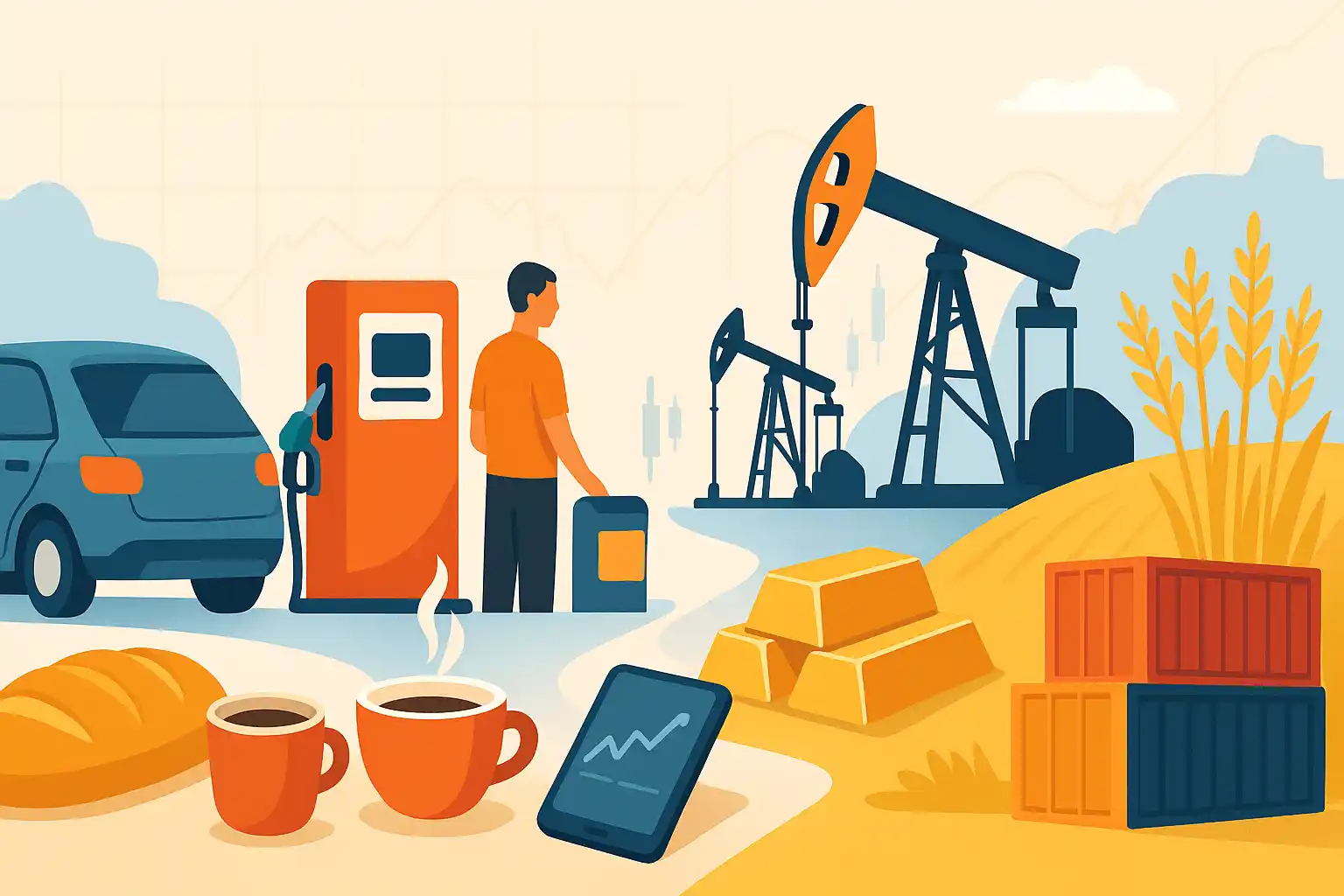
Imagine your morning. You fill up the car, grab a coffee, maybe check your phone which is full of metals and rare materials.
All of that is commodities at work. Fuel in the tank, wheat in the bread, copper in the wires. And yes, you can trade all of it, just like you trade stocks.
This guide is here to walk you through commodities in a way that actually makes sense. If you already know your way around stocks or ETFs, but feel a bit lost when someone says “WTI crude is limit down”, you are in the right place.
You and I are going to go through what commodities are, the main types, how these markets actually work, ways you can trade or invest, how they fit in a portfolio, what moves prices, and the big risks.
What Are Commodities? (Definition & Basics)
Let's start with the simplest question you might be asking yourself right now-the commodity trading basics .
Core definition
A commodity is a basic good or raw material that is used in commerce. Think crude oil, wheat, copper, gold, corn, live cattle.
If you strip it down, a commodity has two key traits:
- It is a basic input for other products or services.
- It is fungible , which is a fancy way of saying one unit is basically the same as another unit of the same grade.
So:
- One troy ounce of 99.99 percent pure gold is effectively the same as another ounce of the same purity.
- One barrel of a specific crude oil grade, like WTI, is treated as equivalent to another barrel of that same grade.
Regulators like the CFTC describe commodity futures as standardized agreements to buy or sell these goods at a future date for a set price, which is how a lot of real world trade is hedged and priced. ( CFTC )
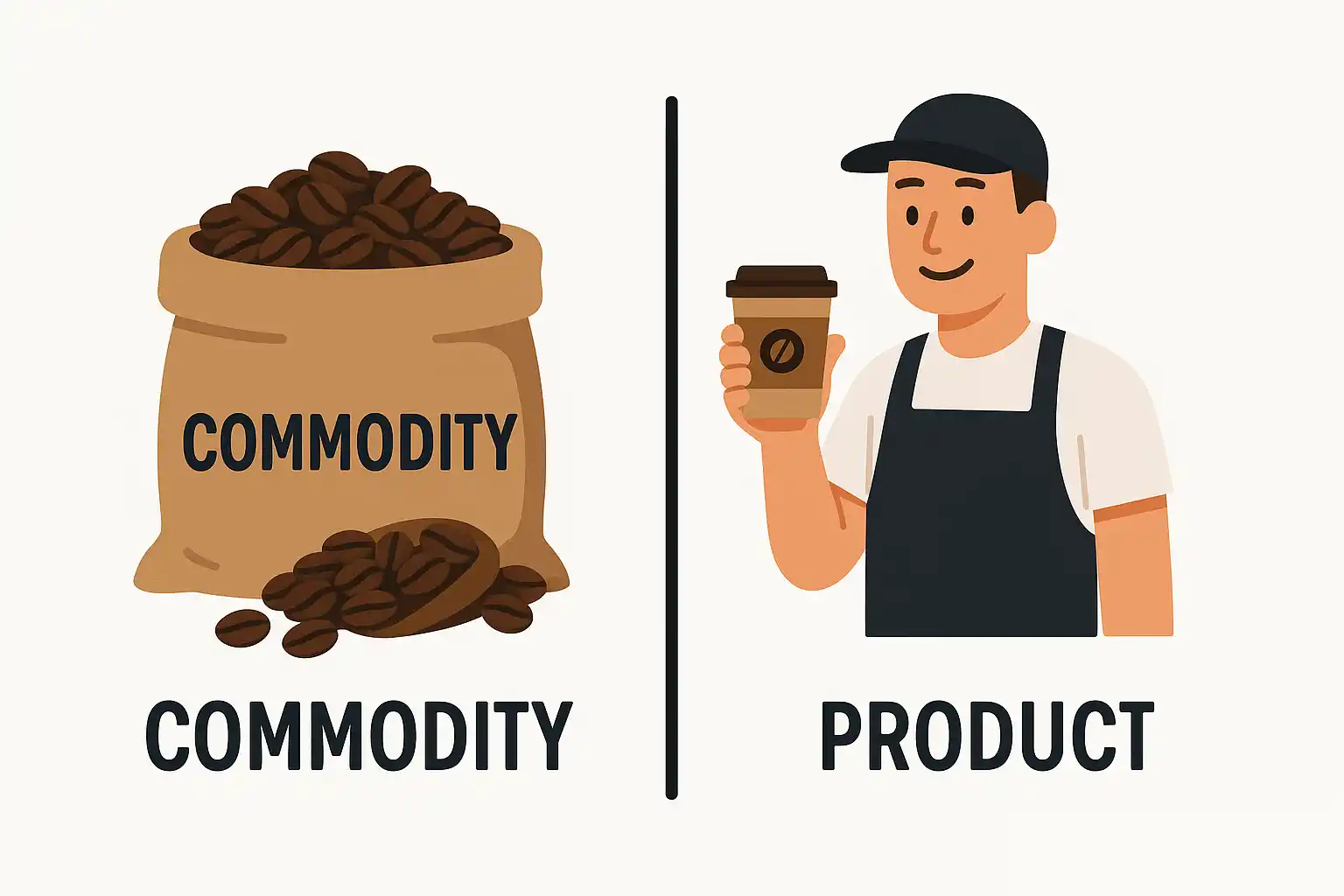
To make this real, picture coffee:
- Coffee beans are the commodity .
- Your fancy caramel oat latte is the branded product built on top of that commodity.
If you trade coffee futures, you care about the beans. Starbucks cares about beans and branding and a lot more.
Everyday and historical context
Commodities trading is not new. It has been around for thousands of years.
- Ancient traders moved spices and grains along trade routes.
- Grain markets in old city centers basically worked as early spot markets.
- In the 19th century, exchanges like the Chicago Board of Trade standardized grain contracts so farmers and buyers could hedge prices ahead of harvest.
Fast forward to you today:
- Your fuel bill is linked to crude oil and gasoline markets.
- Your grocery bill is tied to wheat, corn, soybeans, coffee, sugar and more.
- Your electricity and heating bills reflect energy commodities like natural gas and coal.
- Construction materials for your house, like copper and steel, come from metal markets.
So even if you never trade a single contract, commodities already affect your wallet.
Hard vs soft commodities
You will often hear traders talk about hard and soft commodities.
Hard commodities
These are mined or extracted from the ground:
- Crude oil and natural gas
- Coal
- Metals like gold, silver, platinum, palladium
- Industrial metals like copper, aluminum, zinc, nickel, iron ore
If you are into macro and industrial cycles, you will find yourself watching metals and energy quite a lot.
Soft commodities
These are grown or raised:
- Agricultural crops: wheat, corn, soybeans, canola, cotton, sugar, coffee, cocoa, orange juice
- Livestock: live cattle, feeder cattle, lean hogs
Softs are sensitive to weather, pests, diseases and government policies. A drought or export ban can turn a calm market into chaos pretty quickly.
If you are a beginner, you do not need to memorize every code. What matters is that you start to see the world split into these buckets:
- Hard = dug or pumped out of the ground
- Soft = grown or raised on land
Types of Commodities
Now that you know what a commodity is, let's put some structure around the main groups you will see in trading platforms and research.
Big picture categories
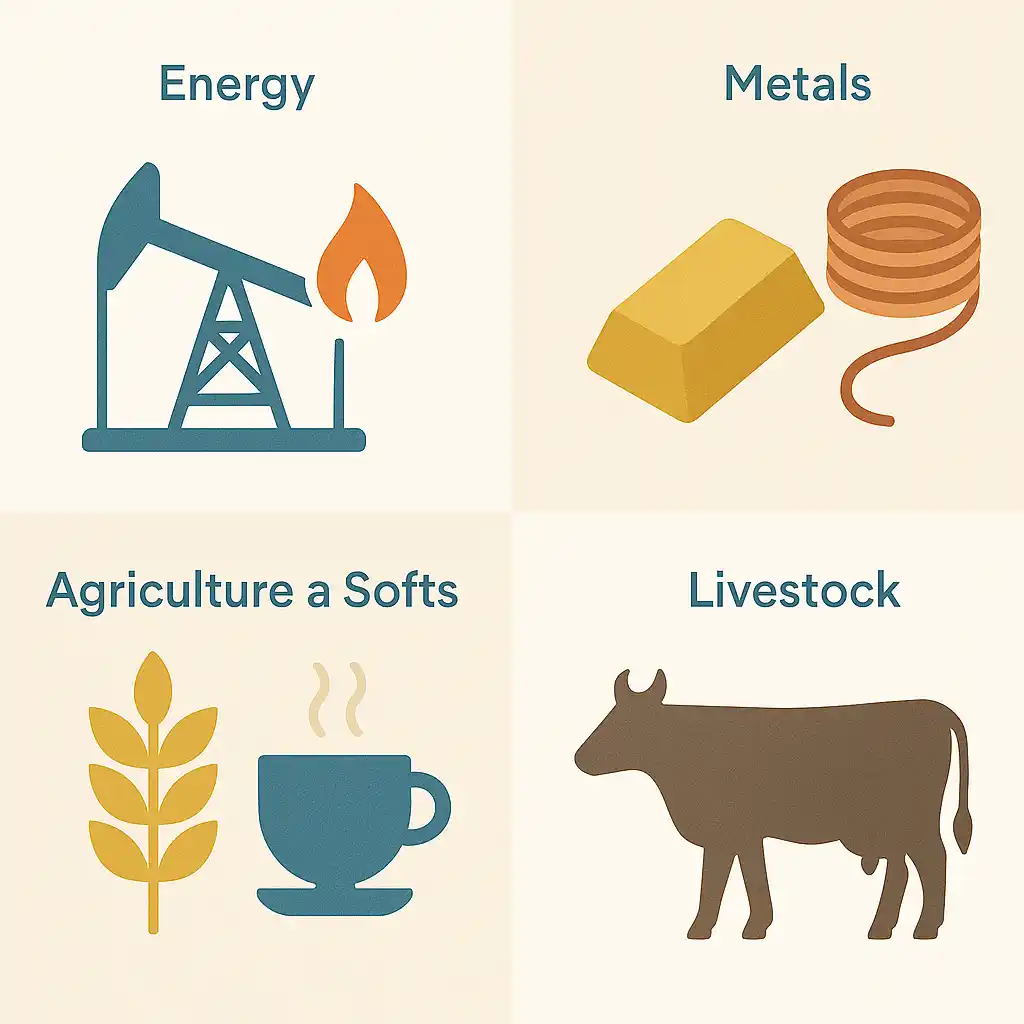
Most traders group commodities into four main buckets:
- Energy
- Metals
- Agricultural and soft commodities
- Livestock and meat
Sometimes people also talk about:
- Environmental commodities , like carbon credits
- Financial commodities , like interest rate or currency futures, and even some digital assets that regulators treat as commodities in certain jurisdictions
In this guide we will keep the focus on traditional physical commodities and the markets built around them.
Energy commodities
If you trade macro, you will bump into energy markets fast. They are central for transport, power, heating and industry, and the energy commodities complex sits at the core of that story.
Common examples:
- Crude oil: WTI, Brent
- Refined products: gasoline, heating oil, diesel
- Natural gas
- Coal
Energy prices are heavily influenced by geopolitics and supply decisions. For example:
- Decisions by OPEC and its partners about production levels
- Sanctions or conflicts affecting major producers or shipping routes
- Changes in demand from big users like the US, China, Europe
If you want to dig into the fundamentals, the International Energy Agency and OPEC both publish a lot of detailed data and reports on energy supply and demand. ( CME Group )
If you are a short term trader, you will care a lot about weekly inventory reports and headlines. If you are more of a long term investor, you will look at bigger trends like energy transition, capex cycles and policy.
Metal commodities
Metals split nicely into precious and industrial metal commodities.
Precious metals
- Gold
- Silver
- Platinum
- Palladium
These live in that weird space where they are both industrial inputs and financial assets.
Gold especially is seen as:
- A store of value
- A hedge against extreme scenarios
- A strategic asset for central banks
The tracks demand from investors, jewelry, technology and central banks, and publishes research on gold's role in portfolios. ( World Gold Council )
Industrial or base metals
- Copper
- Aluminum
- Zinc
- Nickel
- Iron ore
These are tied closely to construction, infrastructure, cars, electronics and general economic growth. Copper even has the nickname “Dr Copper” because it often moves with global economic health.
If you want contract specs and pricing references for metals, the London Metal Exchange is the main hub for many base metals. ( World Gold Council )
Agricultural and soft commodities
If you care about food prices, you care about these markets in agricultural and soft commodities, even if you never open a futures account.
Grains and oilseeds
- Wheat
- Corn
- Soybeans
- Canola and other oilseeds
Softs
- Coffee
- Cocoa
- Sugar
- Cotton
- Orange juice
The big drivers here are:
- Weather and seasons
- Crop yields and planting decisions
- Government policies, subsidies, and export bans
- Global demand trends, for example rising meat consumption increasing demand for feed grains
Livestock and meat
Livestock markets include:
- Live cattle
- Feeder cattle
- Lean hogs
Key drivers for you to watch:
- Feed costs, which tie back to grains like corn and soybeans
- Disease outbreaks that hit herds
- Shifts in consumer demand for meat in different regions
- Trade policies, tariffs and import bans
Even if you never trade these contracts, it helps to know they exist, because they connect back to grain prices and broader food inflation.
Environmental and “financial” commodities
A few quick notes, so you know the terms if they come up in research or news:
- Carbon credits and emissions allowances are traded in some markets as commodities, often via futures.
- Some regulators treat certain financial products and crypto assets as commodities rather than securities, at least for derivatives oversight.
For this guide, though, we will keep our focus on the physical stuff you can dig, pump, grow or raise, and the futures and funds linked to them.
Quick category snapshot
If you like to think visually, keep this simple table in your head:
- Energy: oil, gas, coal, refined products, main drivers are geopolitics and economic growth.
- Metals: precious and base, driven by industry, tech and risk sentiment.
- Agricultural and softs: crops and soft products, driven by weather and food demand.
- Livestock: cattle and hogs, driven by feed costs and meat demand.
Once you can mentally put any commodity you hear about into one of those buckets, a lot of news will start to make more sense.
How Commodity Markets Work (Spot, Futures and Exchanges)
Now let's talk about the actual markets where all this trading happens. This is where beginners usually feel a bit lost at first, so take your time here.
Spot vs futures markets
You will hear two big words a lot: spot and futures .
Spot market
- Also called the cash market.
- This is where the commodity is bought or sold for immediate or near-immediate delivery.
- Used mostly by producers and end users, like farmers, refiners, mills, food companies.
If a mill buys wheat for delivery next week at today's price, that is spot or near spot trade.
Futures market
- Here you trade standardized contracts on an exchange, not one off deals.
- A futures contract is an agreement to buy or sell a specific quantity and quality of a commodity at a set price on a set future date.
- In reality, most traders never go to delivery. They close or roll their positions before the contract expires, so it stays a financial transaction.
Forwards vs futures, quick note
- Forwards are custom, off exchange agreements between two parties.
- Futures trade on exchanges, with standard contract specs and central clearing.
As a retail trader, you will almost always be dealing with futures, not forwards.
Major commodity exchanges
Exchanges bring structure, transparency and clearing to the market. Here are the big names you will see again and again.
-
CME Group
- Includes CME, CBOT, NYMEX and COMEX.
- You get grains and livestock at CBOT, energy at NYMEX, metals at COMEX, plus a lot of financial futures.
- Their education section at CME Group is actually pretty good if you want official explanations of futures and options. ( CME Group )
-
Intercontinental Exchange (ICE)
- Major contracts for Brent crude, coffee, cocoa, sugar, cotton and more.
- Info and contract specs at ICE .
-
London Metal Exchange (LME)
- Key venue for base metals, like copper, aluminum, zinc and nickel.
- Contract information and rules at LME.
There are also important exchanges in Asia, like the Shanghai Futures Exchange, Dalian and MCX in India, but as a beginner you will probably start with CME and ICE contracts in your typical brokerage platform.
Futures contract specs, real examples
To feel the scale of these contracts, let's look at a few examples you might actually see in your trading software.
-
NYMEX WTI Crude Oil Futures
- Symbol often CL.
- Contract size: 1,000 barrels.
- Price quoted in US dollars per barrel.
- Minimum tick is typically 0.01 dollars per barrel, which is 10 dollars per contract.
If you buy one contract and crude goes from 80.00 to 80.50, that 0.50 move is 500 dollars per contract before costs.
-
COMEX Gold Futures
- Standard contract is 100 troy ounces.
- Price quoted in dollars per ounce.
- There are also mini and micro contracts with smaller sizes, which can be useful if you are starting with a smaller account. A useful companion read is alphaex capital.
-
CBOT Corn Futures
- Contract size: 5,000 bushels.
- A move of a few cents per bushel can be a few hundred dollars per contract.
Every futures contract has standardized details:
- Quantity
- Quality or grade
- Delivery location
- Delivery month
This standardization is what allows liquidity. Everyone knows exactly what is being traded.
Who trades commodities
You are probably wondering, who is on the other side of my trade, apart from another speculator?
There are three big groups:
Commercial hedgers
- Producers like farmers, oil and gas companies, miners.
- Consumers like airlines, food companies, utilities, manufacturers.
Their main goal is not to “beat the market”, it is to reduce price risk.
- A farmer may sell corn futures before harvest to lock in a price.
- An airline may hedge jet fuel exposure using crude or fuel derivatives.
This is classic hedging, turning unknown future prices into known numbers so they can plan.
Speculators and traders
This is where retail traders and funds like CTAs, prop firms and hedge funds sit.
- They take on price risk, hoping to profit from moves up or down.
- They help provide liquidity and make it possible for hedgers to offset risk.
If you are trading commodities for profit rather than protecting a business, you are in this group.
Investors via funds
- Pension funds, endowments and individuals often use commodity index funds, ETFs or managed futures funds.
- Their goal is exposure to commodities as an asset class, usually for diversification and inflation hedging.
The CFTC publishes data splitting positions by trader types, which can be interesting if you are into positioning and sentiment.
Clearinghouses and regulation
In futures, you are not directly facing the other trader, you are facing the clearinghouse .
- The clearinghouse stands in the middle of every trade.
- It guarantees performance and handles daily profit and loss through margin.
- This central clearing reduces counterparty risk compared to custom over the counter deals.
On the regulatory side:
- In the US, the CFTC oversees commodity futures and options. ( Congress.gov )
- The NFA supervises futures brokers and trading advisors.
- For commodity ETFs, ETNs and brokerage accounts, the SEC and FINRA play key roles, especially around disclosures and product risk.
If you ever feel lost on the rules, those sites have good plain language warnings about leverage, scams and complex products.
How to Invest or Trade in Commodities
Now for the part you probably care about most. How do you, sitting at your laptop, actually get exposure to these markets?
Main ways to get commodity exposure
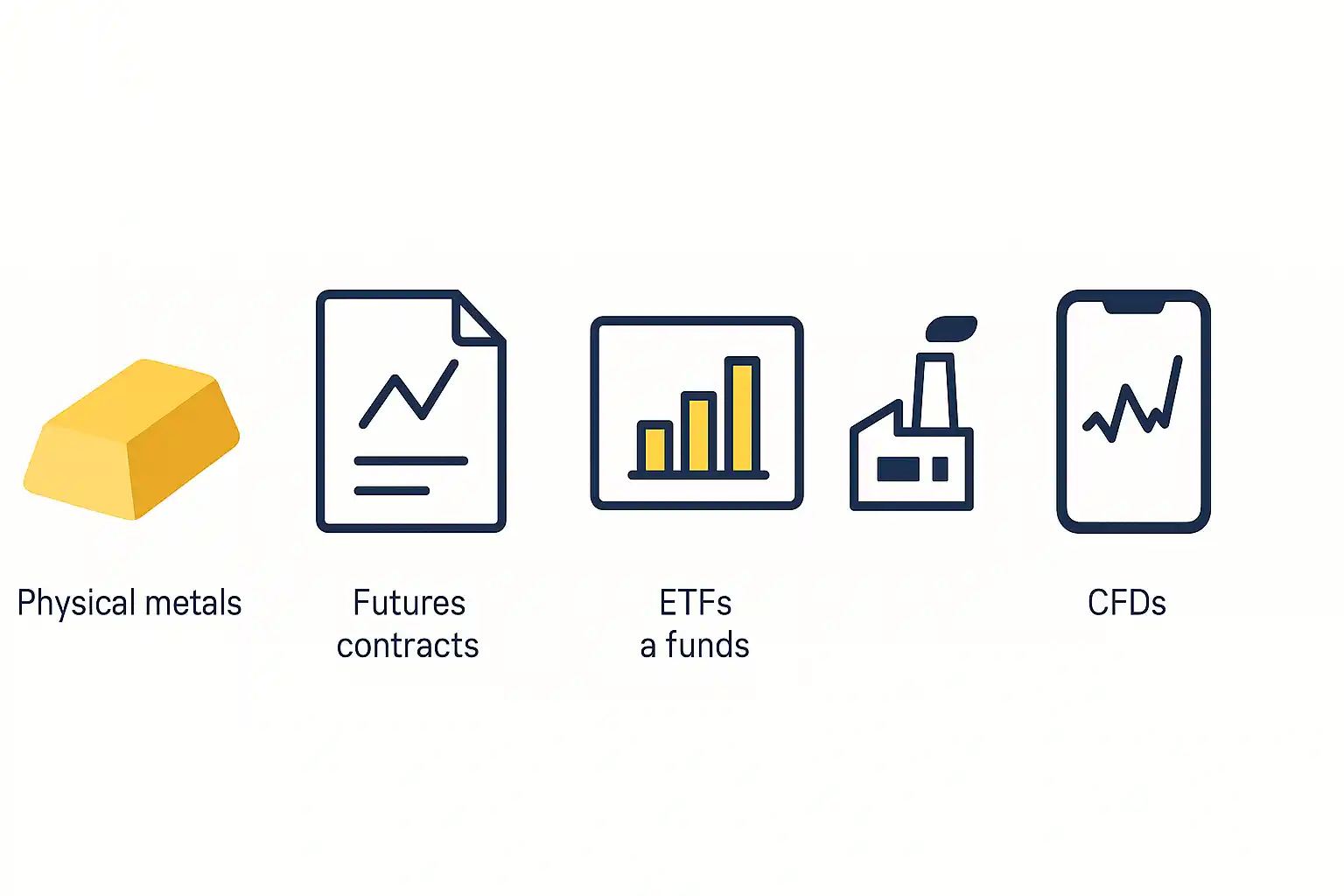
Broadly, you have five paths:
- Physical commodities, mainly precious metals
- Futures and options on futures
- Commodity ETFs, ETNs and mutual funds
- Commodity related stocks
- CFDs and spread betting (outside the US)
Each path has different risk, complexity and capital requirements. So if you are a beginner, do not assume you have to jump straight into full size futures.
Physical commodities, mainly gold and silver
For most individual investors, “physical commodities” means precious metals like gold and silver.
You can buy:
- Bars
- Coins
- Sometimes allocated accounts with vault storage
Pros for you
- You own a tangible asset that does not depend on a broker staying solvent.
- No daily margin calls or mark to market.
- Gold in particular has a long history as a store of value and a strategic asset, backed by central bank holdings and research from groups like the World Gold Council .
Cons
- Storage, insurance and security costs.
- Spreads and dealer markups.
- Harder to trade frequently, it is not as convenient as clicking a button on an ETF.
Also, it is not practical for you to own physical oil, wheat or cattle at scale. That is where futures and funds come in.
Futures and options on futures
This is the purest way to trade commodities prices, but it is also one of the most demanding, so your commodity derivatives and strategies need to match your risk tolerance.
Futures
- Give you direct exposure to the underlying commodity price.
- Use margin, so you control a large notional value with a smaller deposit.
- Most suitable for experienced traders.
Let's take a simple example so you can feel the leverage.
- One standard COMEX gold contract is 100 ounces.
- Price is 1,800 dollars per ounce.
- Notional value is 180,000 dollars.
- If your broker asks for 5 percent margin, that is 9,000 dollars to control 180,000.
If gold moves 10 dollars per ounce in your favor:
- 10 dollars x 100 ounces = 1,000 dollar profit, on 9,000 dollars of margin.
If it moves 10 dollars against you, that is a 1,000 dollar loss instead. A few of those in a row and you can see how people blow up accounts.
Options on futures
Options give you the right, not the obligation, to buy or sell a futures contract at a given price. You can use them:
- To hedge futures or physical positions
- To take directional trades with defined risk
- To build spreads and more advanced structures
Pros
- Deep liquidity in major contracts.
- Ability to go long or short easily.
- Efficient for hedging business or portfolio risks.
Cons
- Complexity, especially with options.
- High leverage and margin calls.
- Contract expiry forces you to manage rolls or exit.
If you are just starting out, many exchanges now offer mini and micro contracts, which can be a more reasonable way for you to learn.
Commodity ETFs, ETNs and mutual funds
If you prefer something closer to regular stock investing, this will feel more familiar.
Physically backed ETFs
- For example, gold ETFs that actually hold bullion in vaults.
- These try to track the spot price of gold, minus fees.
Futures based ETFs and ETNs
- These hold futures contracts instead of physical assets.
- Examples include broad commodity funds tracking indices, or single commodity products like some oil ETFs.
- The fund has to roll contracts as they expire, which creates exposure to contango and backwardation .
That roll effect can be a big deal. In a market with persistent contango, your ETF might lag spot prices significantly, even if you “got the direction right”.
Equity based commodity funds
- These invest in producers, like miners or energy companies, rather than the commodity itself.
- You get a mix of commodity exposure and equity risk.
Pros for you
- Easy to access through regular brokerage accounts.
- Lower capital requirements than futures.
- Good for longer term allocations and diversification.
Cons
- Management fees.
- Tracking error and roll issues.
- Some ETNs carry issuer credit risk, and leveraged ETFs can behave in ways beginners do not expect.
The SEC and FINRA both publish alerts on complex and leveraged ETPs, and it is worth a quick read before you buy anything you do not fully understand.
Commodity stocks, indirect exposure
You can also get commodity exposure through:
- Oil and gas producers
- Miners
- Refiners
- Fertilizer and agribusiness firms
Good bits
- Easy for you to trade.
- You might get dividends.
- You can use your existing equity analysis skills.
Downside
- It is not pure commodity exposure, company level issues matter a lot.
- Things like management quality, balance sheet, politics and ESG policies can dominate the impact of commodity prices.
If you are already experienced with stock picking, this can be a comfortable bridge into the commodity world.
CFDs and spread betting (non US traders)
If you are outside the US, you may see CFDs and spread betting offered on commodities.
- These are leveraged products that track commodity prices without you owning futures or the physical asset.
- Common in the UK, Europe and parts of Asia.
- Not permitted for US retail traders.
The UK regulator, the FCA , has pretty clear warnings on CFDs, pointing out high loss rates for retail traders because of leverage and costs.
If you go down this route, you want to read your broker's risk disclosures carefully and treat leverage with respect.
Comparing the methods, in human terms
You can think about the main methods like this:
- Physical metals: for long term wealth storage and “sleep at night” type holdings, not active trading.
- Futures: for active traders and hedgers who understand margin and can watch positions closely.
- ETFs/ETNs/funds: for investors who want commodity exposure in a portfolio without dealing with roll mechanics directly.
- Stocks: for equity investors who want a commodity tilt via producers.
- CFDs/spread bets: for short term speculative traders outside the US, high risk if misused.
The right choice for you depends on your goal, your time and your risk tolerance.
Trading vs investing mindset
If you are trading commodities, you are usually:
- Looking at short to medium term price moves
- Using leverage
- Watching charts, news and levels every day
- Managing risk trade by trade
If you are investing in commodities, you are usually:
- Thinking in years, not days
- Using ETFs, funds or small physical allocations
- Focusing on diversification and inflation protection
- Rebalancing occasionally, not micro managing daily noise
Neither approach is “better”. What matters is that you are honest with yourself about which one fits your temperament and schedule.
Commodities as an Asset Class in Your Portfolio
Now let's zoom out from individual trades and talk about how commodities fit into a bigger investment picture.
Diversification benefits
Commodities often move differently to stocks and bonds over long periods. That means they can add diversification .
- In some inflationary or supply shock periods, commodities have done well while both stocks and bonds struggled.
- A good recent example was 2022, when commodity indices outperformed many equity and bond benchmarks as inflation spiked.
Research from large asset managers like Vanguard has looked at the role of commodities in portfolio construction, noting their potential to both diversify and hedge inflation risk when used thoughtfully.
Commodities and inflation
Why do people keep saying commodities hedge inflation?
Because commodities are the inputs that become more expensive when inflation rises.
- If energy and food prices spike, that shows up quickly in CPI.
- If metals and building materials jump, construction and manufacturing costs rise.
So, when inflation surprises to the upside, commodities often move higher, sometimes aggressively. Studies have found that commodities can have a high “inflation beta”, meaning they tend to respond strongly to unexpected inflation shocks. ( Advisor Perspectives )
That does not mean you get a perfect hedge every year. It works best in periods of large and unexpected inflation, not mild and well telegraphed price rises.
Volatility and drawdowns
Here is the honest bit you need to hear:
- Commodities are volatile.
- They can fall hard and stay down for a long time.
After the big supercycle peak around 2011, many broad commodity indices went into a long multi year slump. If you had piled in at the top and forgotten about it, the experience would not have felt like a “hedge”.
So if you add commodities to your portfolio, you need to be prepared for:
- Large swings in value
- Potential long flat or down periods
- The emotional side of holding something that can be noisy
Typical allocation thinking
A lot of asset allocation research, including work from firms like Vanguard and others, talks about small to moderate allocations to commodities as part of an overall diversified portfolio, often somewhere in the low single digits to around ten percent in various scenarios, depending on objectives and risk tolerance.
To be clear, this is not a recommendation to you. It is just to show you how professionals often think:
You consider:
- Your time horizon
- Your tolerance for volatility
- Your existing exposure to stocks, bonds and other alternatives
And then you decide whether a slice of commodities makes sense for your situation, or whether the extra complexity is not worth it for you.
Commodity indices and benchmarks
If you use funds, you will probably see these names:
- Bloomberg Commodity Index (BCOM)
- S&P GSCI
Both are broad commodity indices, but their weightings differ a lot, especially for energy. The details matter because:
- An energy heavy index will behave differently to a more balanced one.
- Your experience holding an ETF that tracks each index will not be identical.
When you pick a commodity fund, you are picking a basket and a weighting scheme , not some abstract “commodity exposure”.
What drives commodity prices
If you understand what moves prices, you are less likely to be surprised by big swings, and the right commodity market analysis and tools make that easier. Let's build a simple framework you can use across markets.
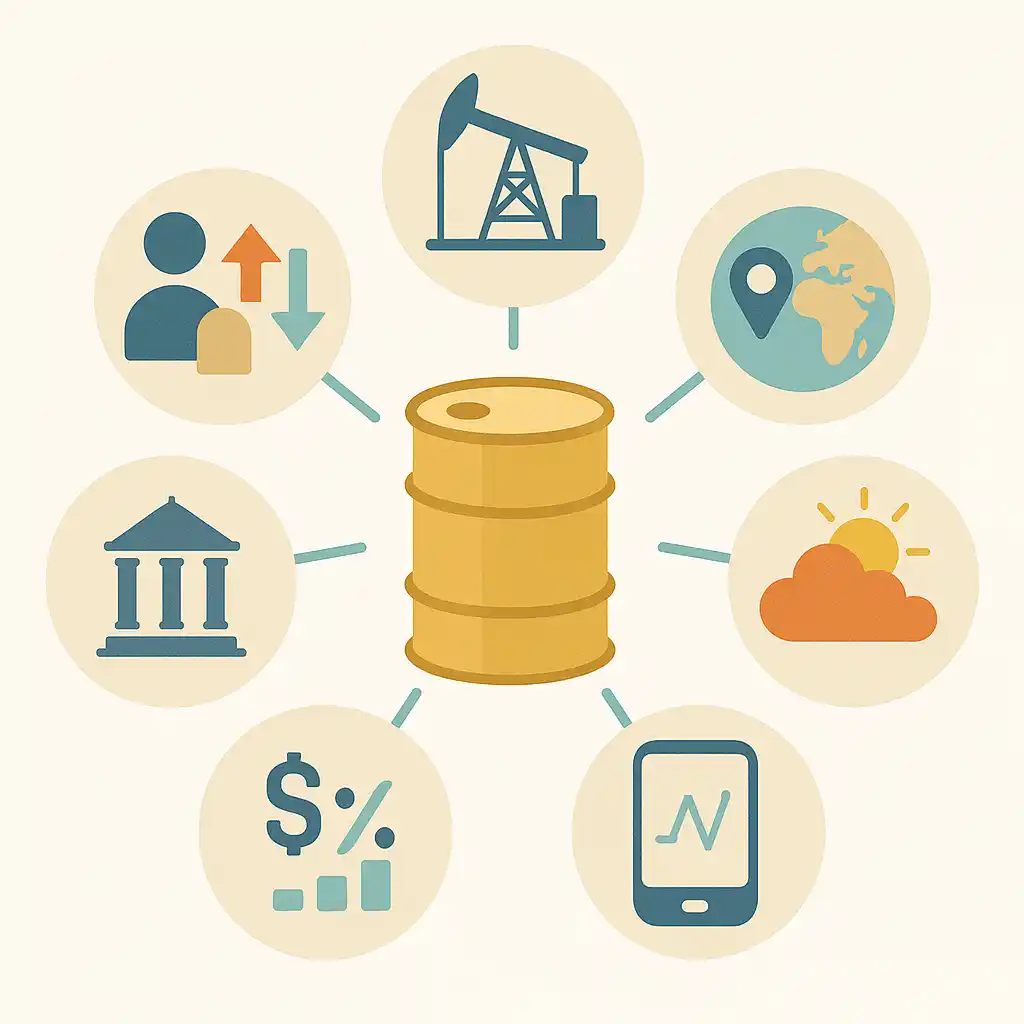
Supply and demand fundamentals
This is the core. No way around it.
Supply side
- Production levels and capacity
- Exploration and capital spending in areas like oil and mining
- Inventory and storage levels
- Disruptions from strikes, accidents, sanctions, logistics issues
Demand side
- Global GDP growth and industrial output
- Consumer trends and urbanisation
- Demographics and income growth
- Sector trends, like electric vehicles boosting demand for battery metals
If you are trading, it helps to follow regular reports:
- For oil, the EIA and OPEC are key for production, demand and inventory data.
- For grains, USDA and FAO give good global snapshots.
Geopolitics and policy
Geopolitics is often the trigger that shocks supply or demand.
You should watch for:
- Wars and conflicts affecting major producers or trade routes
- Sanctions that limit exports
- OPEC and other producer group decisions on output
- Export bans on grains or other key goods
- Releases of strategic reserves, like the US Strategic Petroleum Reserve
A single policy decision can move a market for months if it cuts or adds supply.
Macroeconomy, currencies and rates
Commodities do not live in a vacuum.
- In expansions and booms, demand for energy and metals tends to rise.
- In recessions, demand softens and prices can fall sharply.
The US dollar is a big piece of the puzzle:
- Many commodities are priced in dollars.
- When the dollar strengthens, commodities often come under pressure, because they become more expensive in other currencies.
- When the dollar weakens, the opposite can happen.
Interest rates matter too:
- Higher rates increase the cost of carrying inventories and holding positions.
- Changes in rates also influence investment flows into or out of commodities as people compare them to bonds and cash.
Weather and natural events
For agricultural markets especially, weather is everything.
You want to keep an eye on:
- Droughts, floods and storms
- El Niño and La Niña patterns, which affect regional weather
- Hurricanes affecting offshore oil, gas and refining
- Wildfires and other events that hit infrastructure
Ag traders live with weather models and forecasts. Even if you are a casual trader or investor, it helps to know when the market is nervous about a specific pattern.
Sources like NOAA can give you climate and weather data if you want to see the bigger picture behind those headlines.
Financial flows and speculative activity
Over the years, commodities have become more “financialised”.
- Index funds, commodity ETFs and ETNs, hedge funds and CTAs all move money in and out of markets.
- Algorithmic and trend following strategies can accelerate moves once they start.
This means you can sometimes see large rallies or selloffs that go beyond what fundamentals alone might suggest, especially in the short term.
As a trader, you need to respect that flows can dominate for longer than you think. As an investor, you need to decide whether you are comfortable riding through that noise.
How commodities interact with each other
Commodities also affect each other:
- Oil is a big input for farming, via fuel and fertilizers. High oil prices can mean higher crop costs.
- Power prices affect smelting costs for metals like aluminum.
- Substitution can occur, like shifting from one metal to another in manufacturing if prices diverge.
Traders also look at spreads, for example:
- Crack spreads in refining, the margin between crude and refined products
- Crush spreads in soy markets, between beans and their processed products
You do not need to trade these to benefit from understanding the relationships. Even a simple mental map will help you interpret moves.
A recent style case study
A good recent style example was the energy and grain spike after the pandemic:
- Demand rebounded as economies reopened.
- Then the Russia-Ukraine conflict hit major exporters of energy and grains.
- Energy prices, especially in Europe, spiked.
- Wheat and other grains surged on fears about supply through the Black Sea.
Governments responded with policy measures, releases of strategic reserves, and in some cases export restrictions or subsidies. Prices eventually cooled, but you can see how demand, supply, geopolitics and policy all collided.
If you can read a situation like that and map out those forces, you will be much calmer when screens start flashing red or green.
Risks, Pitfalls and Common Mistakes
Let's talk about the stuff that actually hurts people. It is not fun, but it is important if you want to stay in the game.
High volatility
Commodities can move a lot in a single day.
- Weather surprise, price gaps.
- OPEC decision, crude spikes or dumps.
- Inventory report, gas rips higher.
There have been extreme events, like WTI crude trading below zero in April 2020, or nickel trading being halted on the LME in 2022 after a violent short squeeze.
If you use tight or excessive leverage in these markets, those kinds of moves can wreck your account quickly.
Leverage and margin risk
Futures and CFDs are leveraged products. That means:
- You put up a fraction of the contract value as margin.
- Gains and losses are calculated on the full notional value.
So, if you are at 10 to 1 leverage:
- A 5 percent move in the underlying is a 50 percent move in your equity.
The CFTC and their education office warn clearly that trading futures and options is complex and highly leveraged, and that margin can amplify both profits and losses.
If you are not watching your positions and you do not understand how margin calls work, you can lose more than you planned, and you can be forced out at the worst possible time.
Contango, backwardation and roll yield
If you use futures directly, or you invest in futures based ETFs, you must understand these three words:
- Contango : futures prices are higher than spot prices.
- Backwardation : futures prices are lower than spot prices.
- Roll yield : the gain or loss you experience when you roll from one contract month to the next. Another angle to review is market news.
In contango:
- If you are long and rolling, you sell the cheaper near contract and buy a more expensive later contract.
- That negative roll eats into your returns.
In backwardation:
- You can gain from rolling, because you are selling higher priced near contracts and buying cheaper deferred ones.
Many beginners buy a futures based ETF, see the spot price up over months, and wonder why their ETF is flat or down. The answer is often contango and roll costs.
Complex ETPs and tracking error
Not all commodity ETPs are simple.
- Futures based ETFs can drift away from spot prices over time, especially in persistent contango.
- Leveraged and inverse ETFs reset daily. That daily rebalancing can lead to path dependency, meaning your result depends on the path prices took, not just the start and end points.
Regulators like FINRA and the SEC have issued multiple alerts and bulletins around complex and leveraged ETPs, warning that many investors do not fully understand how they behave in different markets.
If you do not want to dig into a fund's prospectus and structure, be careful with the more exotic stuff.
Liquidity, gaps and limit moves
Not every commodity contract is as liquid as crude oil or gold.
- Thin markets have wider bid ask spreads and more slippage.
- Some contracts have daily price limits. If the market hits limit up or limit down, trading can stop or be constrained.
That means you may not be able to exit when you want, at the price you want. If you are using high leverage in a thin market, you are taking on an extra layer of risk.
Operational and counterparty risk
Even if you are a good trader, operations can trip you up.
You should always:
- Use regulated brokers and platforms.
- Verify that firms and individuals offering you trading advice or managed accounts are properly registered where required.
The CFTC has multiple advisories on fraud in metals and futures trading, and there have been cases where people lost money to scams, not just market moves.
If someone is promising guaranteed returns trading commodities, that is a giant red flag. Markets just do not work that way.
Common beginner mistakes
Here are some patterns I have seen a lot over the years. If you can avoid these, you are already ahead of the pack.
- Using way too much leverage, then panicking on normal volatility.
- Buying an oil or natural gas ETF without reading how it actually works, then being shocked by performance.
- Forgetting that futures contracts expire, and waking up far too close to delivery.
- Chasing a parabolic move at the end of a cycle, buying what everyone on social media is hyping.
- Revenge trading after a loss, trying to “win it back” in a fast market.
If you recognize yourself in any of those habits, you are not alone. The important part is that you notice it and change your process.
Risk management, your survival kit
Good risk management in commodities is not some fancy institutional thing. For you, it can be quite simple:
- Keep position sizes small relative to your account, especially at the start.
- Use stop losses or other exit rules that you set in advance.
- Limit your total leverage.
- Diversify across different commodities and asset classes rather than putting everything in one idea.
- Write down a basic trading plan, even if it is one page, and stick to it when emotions run high.
If you want quick numbers, the position size calculator helps you size trades, and the drawdown recovery calculator shows how much you need to make back after a loss. A related example is about alphaex capital - our mission & expertise 2026.
And remember, commodities are not suitable for everyone. There is nothing wrong with deciding that the volatility and complexity are not worth it for your situation.
How to Get Started with Commodities (Step by Step)
If you are feeling a bit overwhelmed, let's slow down and turn all of this into a simple sequence you can follow.
Step 1: Be clear on your goal
Ask yourself honestly:
- Are you mainly trying to hedge inflation or diversify a long term portfolio?
- Or do you want to actively trade commodity prices for profit?
If you just want diversification, you probably do not need to trade futures intraday. A suitable ETF might do the job. If you want to trade, you need to be ready for a learning curve and a lot more screen time.
Step 2: Choose your vehicle
Match your goal to the tool:
- Long term hedge or diversification: look at broad commodity ETFs or specific ones like a gold ETF you understand.
- Interest in gold as a store of value: maybe small physical holdings or a physically backed ETF.
- Active trading and hedging: futures and options, or in some regions, CFDs or spread bets.
- Comfortable stock investor: consider commodity producers or sector funds.
If you are unsure, start with the simpler stuff first. You can always add complexity later once you know more.
Step 3: Pick your broker or platform
Look for:
- Regulation in a solid jurisdiction.
- Clear fee and margin structures.
- Good platform stability and risk tools.
- Access to the markets you actually want: futures, ETFs, or both.
If you plan to trade futures, make sure the broker is registered appropriately and supervised by bodies like the NFA or equivalent in your region.
Step 4: Start small and learn
This is the part most people skip, then regret it.
- Use paper trading or a demo account at first to get comfortable with contract specs and platform mechanics.
- If you go live, start with the smallest contract sizes available, for example micro futures if they exist in your market.
- Focus on learning and execution, not on trying to hit big profit targets.
Think of it like learning to drive. You do not start with a race car in the rain.
Step 5: Build a simple risk plan
Write down a few concrete rules:
- Max percentage of your account you will risk per trade.
- Max percentage of your account you will risk across all open commodity positions.
- When you will scale up or down size.
- How you will react after a big loss or a streak of losses.
Stick that plan somewhere you can see it. You will be tempted to ignore it at some point. That is exactly when it is most valuable.
Step 6: Stay informed, without drowning in info
You do not need to read every report on earth, but you should have a basic information routine:
- A calendar of major reports, like EIA inventories for oil, USDA reports for grains, central bank meetings, inflation data.
- A couple of trusted sources for macro and commodity news.
You want enough information to understand what is moving the market, not so much that you never place a trade.
If you combine this step by step approach with patience, you will give yourself a much better chance of making commodities work for you, rather than against you.
Commodities FAQs
Here are some common questions you might be asking yourself, answered in a way that can stand alone if you are skimming.
What is a commodity in simple terms?
A commodity is a basic raw material that is used to make other goods or provide services. Think oil, wheat, copper, gold, coffee, cattle.
The key is that one unit of the same grade is basically interchangeable with another. One ounce of 99.99 percent gold is as good as another ounce of the same purity. That is what makes standardized trading possible.
If you are comfortable with the idea of “shares” of a company, you can think of commodities as standardized units of raw stuff.
What are the main types of commodities?
You will usually see four main groups:
- Energy, like crude oil, natural gas and refined products.
- Metals, split into precious metals like gold and silver, and base metals like copper and aluminum.
- Agricultural and soft commodities, like wheat, corn, soybeans, coffee, cocoa, sugar and cotton.
- Livestock, mainly live cattle, feeder cattle and lean hogs.
Some people also talk about environmental and financial commodities, but if you get those four buckets clear, you will already understand most of the market.
How can I invest in commodities without trading futures?
If you do not want to mess with futures or margin, you have a few options:
- ETFs and mutual funds that track commodity indices or specific commodities.
- Physically backed ETFs , especially for gold and silver.
- Commodity producer stocks , like oil companies or miners, which give you indirect exposure.
Each option has its own pros and cons, but they all let you use a normal brokerage account.
What is the difference between hard and soft commodities?
- Hard commodities are mined or extracted, like oil, gas, gold, copper and other metals.
- Soft commodities are grown or raised, like wheat, coffee, cocoa, sugar, cotton and livestock.
If you remember “hard is from the ground, soft is from the land”, you will be fine.
What does it mean when oil is in contango or backwardation?
These are terms used to describe the .
- Contango : later dated futures are more expensive than nearer ones.
- Backwardation : later dated futures are cheaper than nearer ones.
If you are trading or investing using futures, or using a futures based ETF, this shape matters a lot, because you have to roll from one contract month to another. That roll can either help you or hurt you depending on whether the market is in contango or backwardation.
Are commodities a good hedge against inflation?
Commodities have historically been one of the stronger hedges against unexpected inflation, especially during big inflation shocks. Research from firms like CME Group and Vanguard has highlighted their inflation hedging potential.
But that does not mean they are a magic solution. You still face volatility, long drawdowns and periods where the hedge feels uncomfortable.
Why are commodity prices so volatile?
Several reasons:
- Supply is often rigid in the short term. You cannot instantly grow more crops or build a new mine.
- Demand can change quickly with economic cycles and policy.
- Weather, wars, sanctions and policy shifts can hit supply out of nowhere.
- Financial flows from funds and speculators can amplify moves.
Put all of that together and you get markets that can be calm one month and wild the next.
Do commodities pay dividends or interest?
The commodities themselves do not pay dividends or interest. A barrel of oil is just a barrel of oil. A bar of gold just sits there.
You can get income from:
- Stocks of commodity producers that pay dividends.
- Some funds that distribute income or interest from collateral.
But if you are holding pure commodity exposure, you are relying on price moves and maybe roll yield, not dividends.
How do commodity futures contracts work?
A commodity futures contract is a standardized agreement to buy or sell a specific amount and quality of a commodity at a set price on a set date in the future.
Key points for you:
- You trade it on an exchange, like CME or ICE.
- You post margin, not the full contract value.
- Your profit and loss is settled daily, based on price changes.
- Most traders close or roll positions before the contract reaches delivery.
What is an example of using commodities to hedge business risk?
Classic example: an airline and jet fuel.
- The airline worries oil prices might spike and push up fuel costs.
- It can use crude oil or fuel futures to lock in some of its future costs.
- If oil prices rise, the extra fuel cost is partly offset by profits on the hedge.
Farmers, food manufacturers, miners and many other businesses do similar things. It is all about turning unknown future prices into known numbers so they can plan.
What are common mistakes beginners make in commodity trading?
Some of the big ones:
- Trading full size futures contracts with a small account.
- Ignoring contract specs and notional value.
- Trading a futures based ETF like it is a stock, without understanding contango or roll.
- Piling into a hot market just because social media is buzzing.
- Moving stops further away or removing them entirely when a trade goes against them.
If you can avoid those and keep risk small, you give yourself a much longer runway to learn.
Is commodity trading suitable for beginners?
It can be, but only if you treat it with a lot of respect.
If you are a beginner:
- Start with education and maybe paper trading.
- If you go live, use small size and low leverage.
- Consider starting with ETFs or producers rather than full blown futures.
Regulators like the CFTC are clear that trading leveraged products like futures and options involves substantial risk and is not suitable for all investors.
How much of my portfolio should be in commodities?
There is no fixed “right” number for everyone.
- Some institutional research suggests small to moderate allocations can make sense in certain portfolios, often a few percent up to around ten in various scenarios.
- Your own allocation, if any, should be based on your goals, risk tolerance and time horizon.
Treat any number you see in a study as an input, not a rule.
What is the difference between commodity ETFs and commodity stocks?
- Commodity ETFs usually try to track the price of a commodity or a basket of commodities, either by holding the physical asset or by holding futures.
- Commodity stocks are companies that produce or process commodities.
So, if you buy a gold ETF, you are getting price exposure to gold. If you buy a gold miner, you are getting exposure to gold plus company specific risks.
15. Can you lose more than your initial investment trading commodities?
Yes, with leveraged products you can.
- With futures and some CFDs, losses can exceed your initial margin if the market moves sharply against you and you cannot meet margin calls.
- With some ETFs and ETNs, your loss is limited to the capital you invested, but you can still lose a lot if the product behaves differently than you expect.
Always check the structure of the product you are using and read the risk section carefully.
Key Commodity Trading Terms (Quick Glossary)
To finish off, here is a quick glossary you can refer back to when terms show up in other guides.
- Commodity : A basic raw material used in commerce, like oil, wheat or copper, where one unit of a given grade is interchangeable with another.
- Futures contract : A standardized agreement traded on an exchange to buy or sell a set amount of a commodity at a set price on a future date.
- Option on futures : A contract that gives you the right, but not the obligation, to buy or sell a futures contract at a specific price within a set period.
- Spot market : The market for immediate or near term delivery of the physical commodity.
- Hedging : Taking a position in futures or options to reduce the risk of an existing exposure, like a farmer locking in crop prices.
- Speculation : Taking positions purely to profit from price moves, without an underlying business exposure.
- Margin : The deposit you must post to open and hold a leveraged position in futures or similar products.
- Initial margin : The amount you need to open a position.
- Maintenance margin : The minimum balance you must keep to hold the position, below this you can get a margin call.
- Contango : When longer dated futures are priced higher than nearer ones.
- Backwardation : When longer dated futures are priced lower than nearer ones.
- Roll yield : The gain or loss that arises when you roll a futures position from one contract month to another.
- Basis : The difference between the spot price and the futures price of a commodity.
- Tick size : The minimum price increment a futures contract can move.
- Notional value : The total value of the underlying exposure of a position, for example contract size multiplied by price.
- ETF / ETN : Exchange traded fund and exchange traded note, both are tradeable vehicles that can give you exposure to commodities, but with different structures and risks.
If you keep this glossary handy and check it when something feels fuzzy, you will find your understanding of commodities compounds quite fast over time.