Indices Are The Barometer of the Global Economy
Think of indices as the pulse of the financial markets. When you hear someone say "the market is up today," they aren't talking about every single stock in existence, they are talking about an index. An index is basically a statistical measure that tracks the performance of a specific group of assets, acting like a "basket" to represent a whole market or a specific sector.
To put it simply, imagine an index is like a thermometer. It gives you the temperature of the market to tell you if it's healthy or sick, but it isn't the weather itself. You look at it to gauge what's happening, but you don't go outside and "stand in the thermometer."
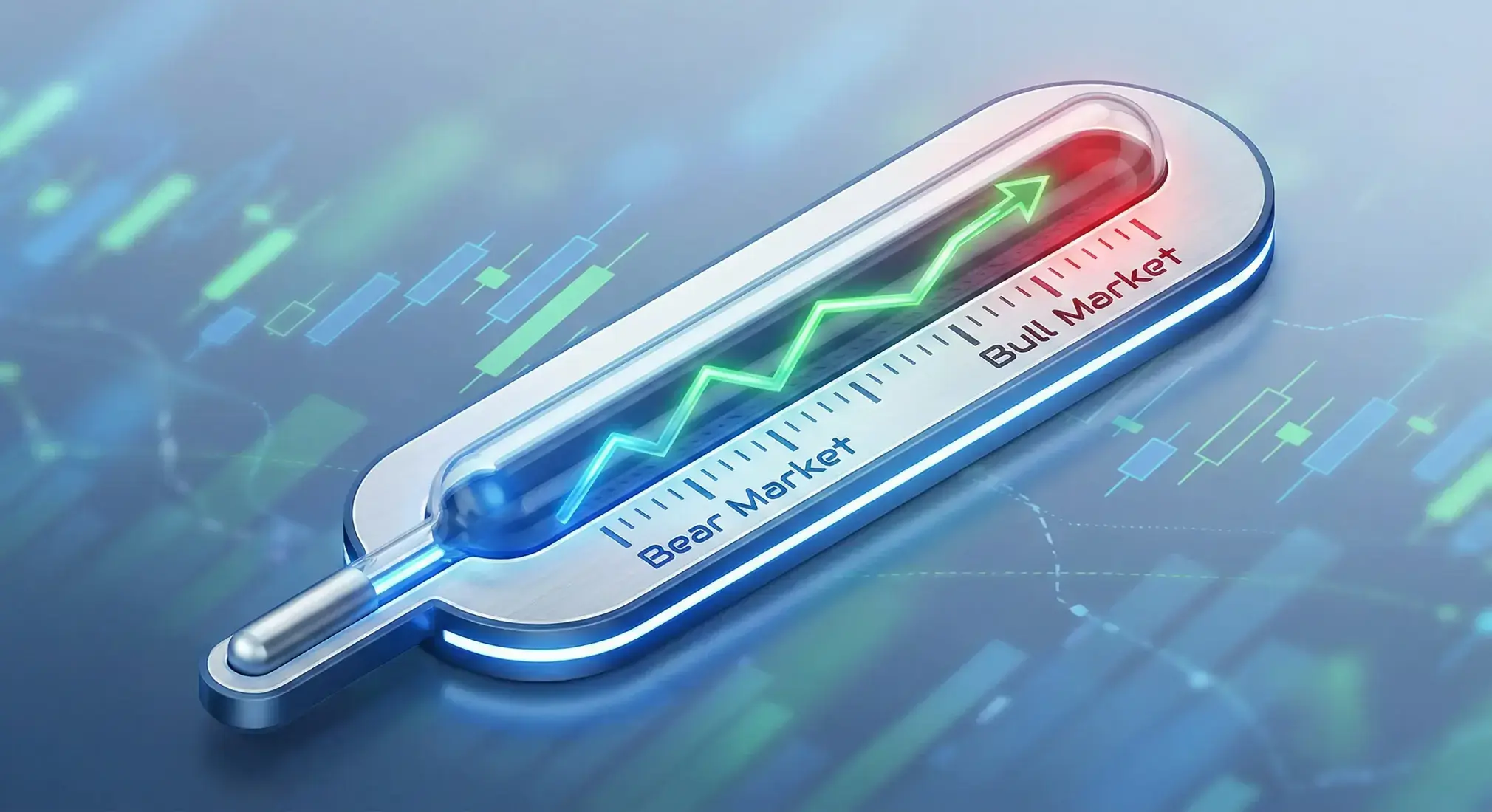
Here is the thing that catches most beginners off guard. You cannot invest directly in an index . It is just a number, a mathematical score calculated from those assets. You can't buy the score. If you want to get involved, you have to use specific financial products. Investors usually use things like ETFs or Index Funds, while traders might use CFDs or Futures to speculate on where that score is going next.
In this guide, I'm going to walk you through exactly how these things work, the different types you'll see out there, and how you can actually use them whether you want to day trade or save for retirement.
Index Basics: How They Work
One of the first things you'll notice is that an index value is measured in "points," not dollars, pounds, or yen. If the S&P 500 moves from 4,000 to 4,100, that is a change in points. This movement represents a percentage change in the collective value of all the companies in that basket, relative to whenever the index started.
The Role of Benchmarks
We use these points as benchmarks for two main reasons. First, they define market health. News outlets love to scream "The Dow is down" because it is a quick way to summarize complex movements across the whole economy.
Second, they are used for performance comparison. If you are picking your own stocks or paying a fund manager, you need to know if it's worth the effort. You ask yourself, "Did I beat the S&P 500?". If you didn't, you might have been better off just buying the market itself. Understanding these foundational Index Basics and Concepts is critical before you start putting money on the line.
Types of Indices
Not all indices are created equal. They come in different flavors depending on what they track.
Equity Indices (Stock Market Indices)
These are the ones you see on the news. Equity Indices track baskets of stocks and we usually categorize them by where they are or how big the companies are.
- Global Indices: These give you a snapshot of the entire world economy. The MSCI World is a classic example that tracks developed markets everywhere.
- National Indices: These track the economy of a single country. In the US , you have the S&P 500 , and in the UK , you have the FTSE 100 . We also break out regional hubs for Europe , Asia , and Canada .
- Sector Indices: These focus on specific industries. If you only care about tech or healthcare, there is an index for that.
Bond and Fixed Income Indices
Stocks get all the glory, but bond markets are huge. Unlike stock indices, Bond and Fixed Income Indices track the value of bond portfolios, like government treasuries or corporate debt.
A big name here is the "Agg," or the Bloomberg US Aggregate Bond Index . It acts as the primary benchmark for the bond market. These are vital for conservative investors who are watching interest rates rather than company earnings. You can verify the components of such indices directly at providers like Bloomberg Indices to see exactly what debt you are tracking.
Sector and Thematic Indices
Sometimes you want to invest in a trend, not a country. That is where Sector and Thematic Indices come in. These go beyond geography to track massive shifts like Clean Energy, Artificial Intelligence, or ESG (Environmental, Social, and Governance) factors.
You also have something called "Smart Beta" or Factor Indices. These are built based on specific financial metrics, like picking stocks with "Low Volatility" or "High Dividend Yield," rather than just grabbing the biggest companies.
Other Key Index Types
There are two other oddballs you should know.
- Volatility Indices (The VIX): People call this the "Fear Gauge". It measures expected future market volatility rather than the current price of stocks. It often moves in the opposite direction of the stock market-when panic goes up, the VIX goes up.
- Currency Indices: These track the strength of a specific currency. The US Dollar Index (DXY) measures the dollar against a basket of foreign currencies like the Euro and Yen.
How Indices Are Calculated (Weighting Methods)
You might assume an index just adds up stock prices and divides by the number of stocks. It is rarely that simple. How an index is built changes how it behaves.
Market Capitalization-Weighted
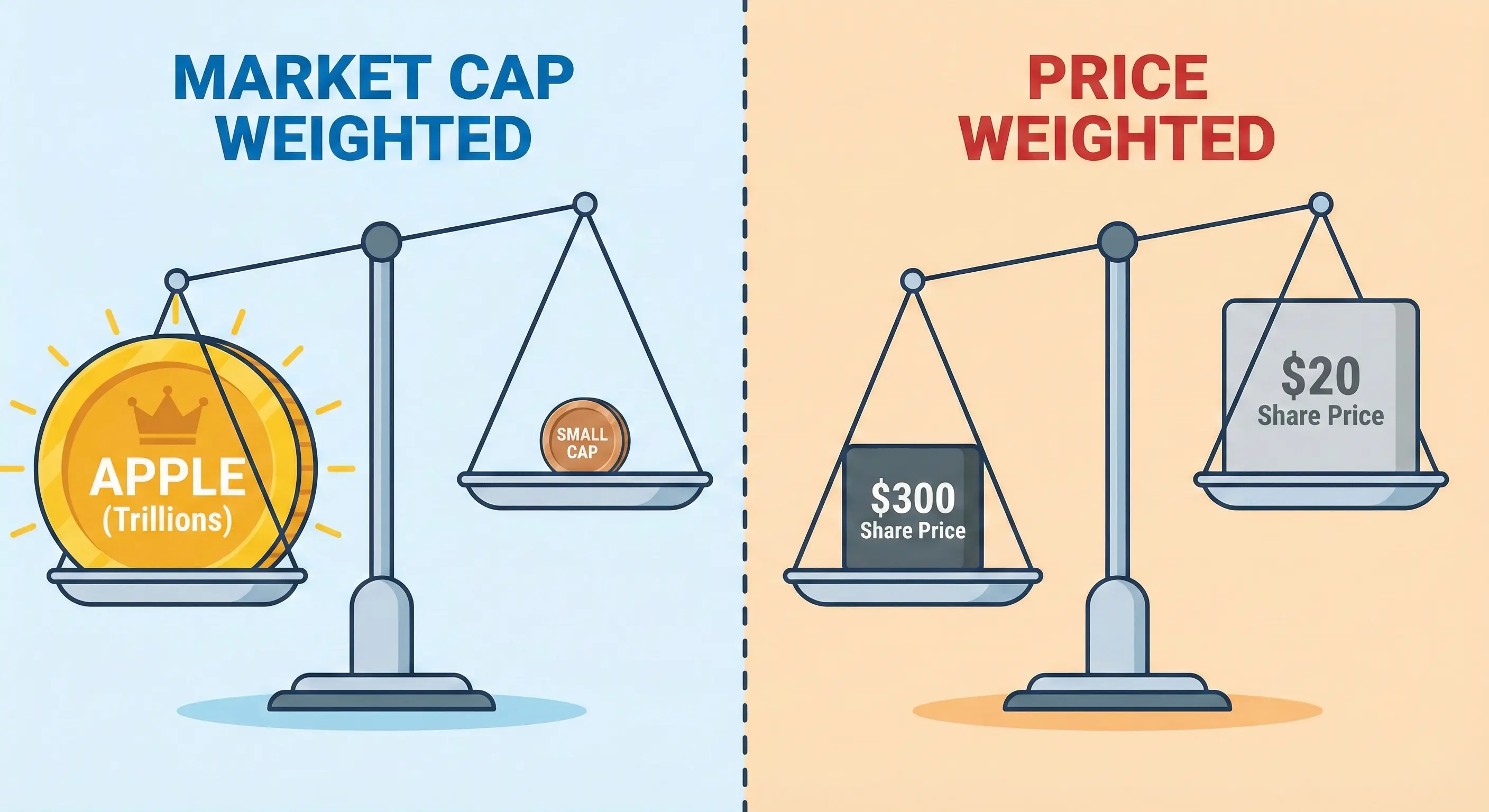
This is the most common method. Companies are weighted by their total market value (Share Price × Total Shares). The larger the company, the more it moves the index.
Examples include the S&P 500 , FTSE 100 , and NASDAQ-100 .
The implication here is "concentration risk". If a few massive tech giants have a bad day, they can drag the whole index down, even if the other 490 companies are doing fine. It's worth checking the factsheets on sites like S&P Global to see just how heavy the top 10 stocks are in the index right now.
Price-Weighted
This one is a bit old-school. Companies are weighted solely by their share price. A stock trading at $300 has three times the influence of a stock trading at $100, regardless of how big the actual company is.
The famous examples are the Dow Jones Industrial Average (DJIA) and the Nikkei 225 .
Equal-Weighted
In this method, every company gets the exact same percentage weight. It gives smaller companies equal influence to the giants.
One last thing to remember is that indices aren't static. They get rebalanced (weights adjusted) or reconstituted (companies added or removed) periodically to make sure they stay accurate. When a company gets added to a major index, its price often pops because all the funds tracking that index have to buy it.
The "Big 5" Global Indices (Reference Table)
If you are just starting out, these are the heavy hitters you will see quoted every day.
| Index | Region | What It Is | Weighting |
|---|---|---|---|
| S&P 500 (US 500) | USA | The gold standard for the US economy, covering ~80% of market cap. | Cap-weighted |
| Dow Jones (US 30) | USA | 30 Blue-chip industrial giants. The oldest active US index. | Price-weighted |
| Nasdaq-100 (US Tech) | USA | The benchmark for Tech and Growth stocks. | Cap-weighted |
| FTSE 100 (UK 100) | UK | The primary UK benchmark, heavy in energy and financials. | Cap-weighted |
| DAX 40 (Germany 40) | Germany | Europe's industrial engine, containing giants like VW and Siemens. | Cap-weighted |
Honorable mentions go to Japan's Nikkei 225 and Hong Kong's Hang Seng , which is a gateway to Asian markets . We also track regional benchmarks in Latin America and Africa .
Strategy Guide: Investing vs. Trading Indices
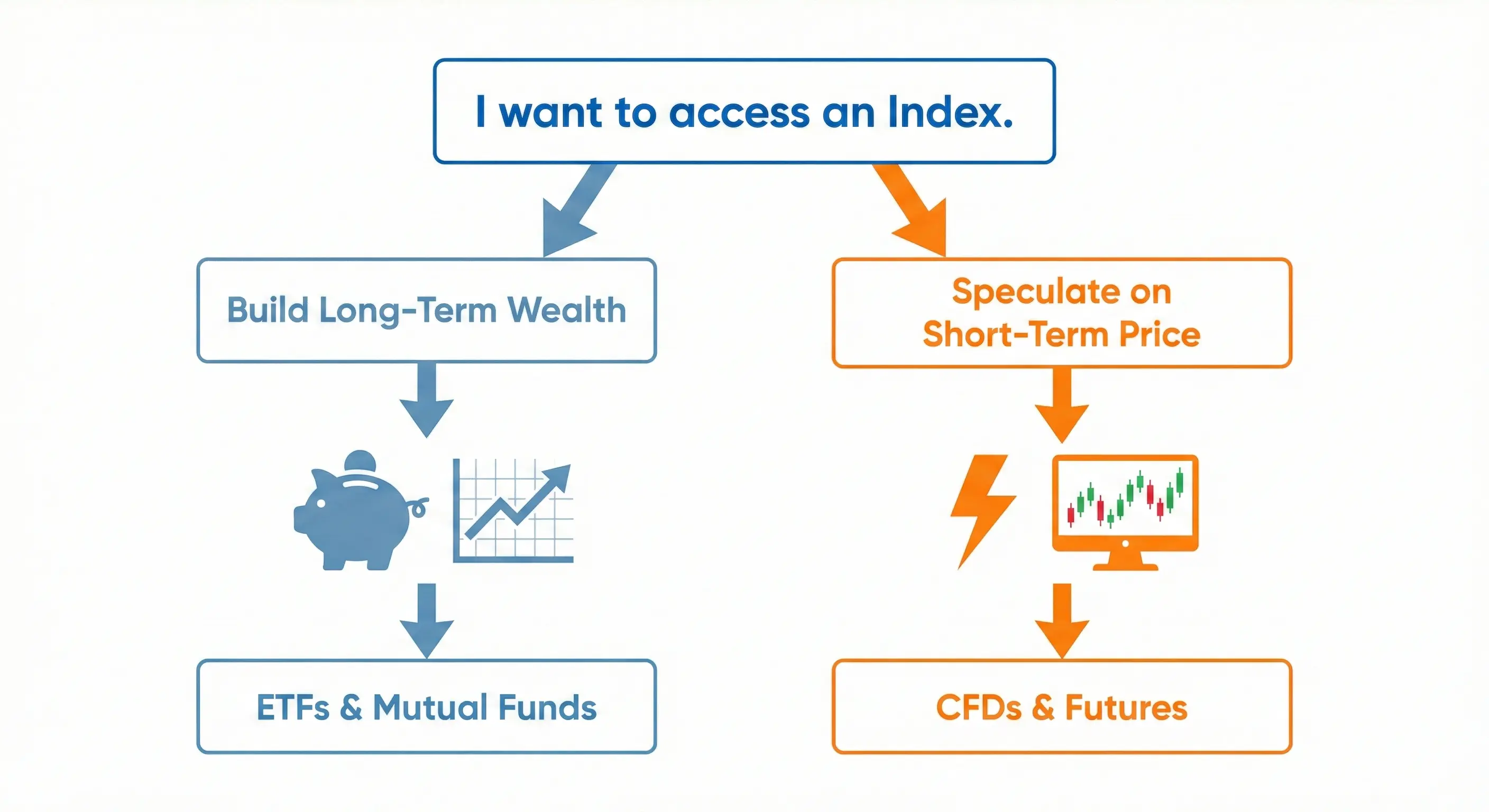
Now we get to the practical part. How do you actually make money with these? It depends on if you want to apply Index Investing and Trading strategies to be an active participant or a passive observer.
Index Investing (The Passive Approach)
The goal here is long-term wealth accumulation. You want to capture broad market growth over years or decades.
Primary Instruments:
- Index Funds: These are mutual funds that replicate an index. They are priced once daily and are ideal for automated savings in retirement accounts.
- ETFs (Exchange-Traded Funds): These trade like stocks on an exchange. They offer high liquidity, tax efficiency, and usually have very low expense ratios. Think symbols like SPY or VOO .
Key Benefits: You get low fees, instant diversification, and history is on your side regarding market appreciation. For a deeper look at fund flows and popularity, you can check data on Morningstar to see which index funds are attracting the most capital.
Index Trading (The Active Approach)
The goal here is speculation. You are betting on short-term price movements (up or down) or using indices to hedge a portfolio you already own.
Primary Instruments:
- CFDs (Contracts for Difference): These are derivatives that allow you to profit from price changes without owning the asset. They allow for leverage and short selling, but be careful-they are high risk.
- Futures: These are standardized contracts traded on exchanges like the CME. Professionals love them for their high volume and the fact that you can trade them nearly 24/5.
Key Benefits: You can profit from falling markets (shorting) and use leverage to amplify your returns, though that leverage cuts both ways.
What Moves Index Prices? (Key Drivers)
Indices don't just move randomly. They react to specific engines in the economy.
Macro-Economic Factors
- Central Bank Policy: This is the big one. Interest rates are the primary driver of value. When rates go up, it generally pressures stock indices because borrowing gets expensive.
- Economic Data: Reports on GDP, Inflation (CPI), and Employment (NFP) can cause immediate volatility. If the data surprises the market, watch out.
Micro-Economic Factors
- Earnings Season: Quarterly results from the major companies matter. If Apple or Microsoft miss their numbers, they can drag the entire S&P 500 down with them.
- Sentiment & Geopolitics: Markets run on emotion. "Risk-on" sentiment sends stocks up, while "risk-off" sentiment-driven by elections, wars, or instability-sends them down.
Benefits, Risks, and Critical Warnings
Before you put money down, you need to know the score.
Benefits:
- Diversification: You remove single-company bankruptcy risk. An index rarely goes to zero unless the whole world ends.
- Simplicity: You don't need to analyze individual balance sheets or read 50 annual reports.
Risks:
- Systemic Risk: Diversification does not protect you against a total market crash. In 2008 or the 2020 COVID crash, everything fell together.
- Concentration Risk: Being "diversified" in the S&P 500 still means you have heavy exposure to the tech sector because of how big those companies are. Regulators like the FCA often warn about the dangers of leverage in these markets, and it's advice worth listening to.
Risk Warning: Leverage Risk is real for traders. Using margin in CFDs or Futures magnifies your losses. It is entirely possible to lose more than your initial deposit if you aren't careful.
Frequently Asked Questions (FAQ)
Can you buy an index directly?
No, you can't. You must use a fund (like an ETF) or a derivative (like a Future) to trade it.
What is the best index for beginners?
Broad market indices like the S&P 500 or MSCI World are standard starting points because they cover so
much of the economy.
Do indices pay dividends?
The price index itself does not, but if you buy a Total Return index fund or ETF, those dividends are
collected and reinvested for you.
Is trading indices risky?
Yes, especially if you use leverage. Investing is generally lower risk but is still subject to market
volatility.